

Automatic Vacuum Circuit Breaker: How It Works and Why It Matters
2026-11-16
Every automatic vacuum circuit breaker has a moment of truth—the instant a fault current appears, it must act before damage spreads. That’s where vacuum technology shines, with no gas to leak or oil to maintain, just a clean interrupt in milliseconds. In this post, we’ll explore the how and why behind these devices, and along the way you’ll see why XIAOPAI treats them as a cornerstone of modern electrical safety.
What Actually Happens Inside the Vacuum Bottle When Contacts Separate?
The moment the contacts begin to part, the current flowing through them doesn't simply stop. Instead, it concentrates into a tiny, intensely hot spot on the last point of contact. As that microscopic bridge is stretched and finally ruptured, the metal there vaporizes almost instantly, filling the gap with a dense cloud of ionized metal vapor. This vapor is what carries the arc across the widening separation.
Inside the vacuum, the arc behaves differently than in air or oil. Because there is no surrounding gas to sustain ionization, the metal vapor alone must feed the discharge. As the alternating current approaches its natural zero crossing, the rate of vapor production drops sharply. The ionized particles rapidly recombine and condense back onto the contacts and nearby shields. By the time the current reaches zero, the gap has already recovered enough dielectric strength to prevent the arc from reigniting—so the circuit is cleanly interrupted.
Any residual vapor that does not condense immediately is captured by the surrounding metal shields, which act as getters to keep the vacuum quality high. This self-quenching cycle is what allows a vacuum interrupter to handle thousands of operations with almost no contact wear compared to other interruption technologies.
The Automatic Trip Logic: From Overcurrent Detection to Full Isolation in Milliseconds
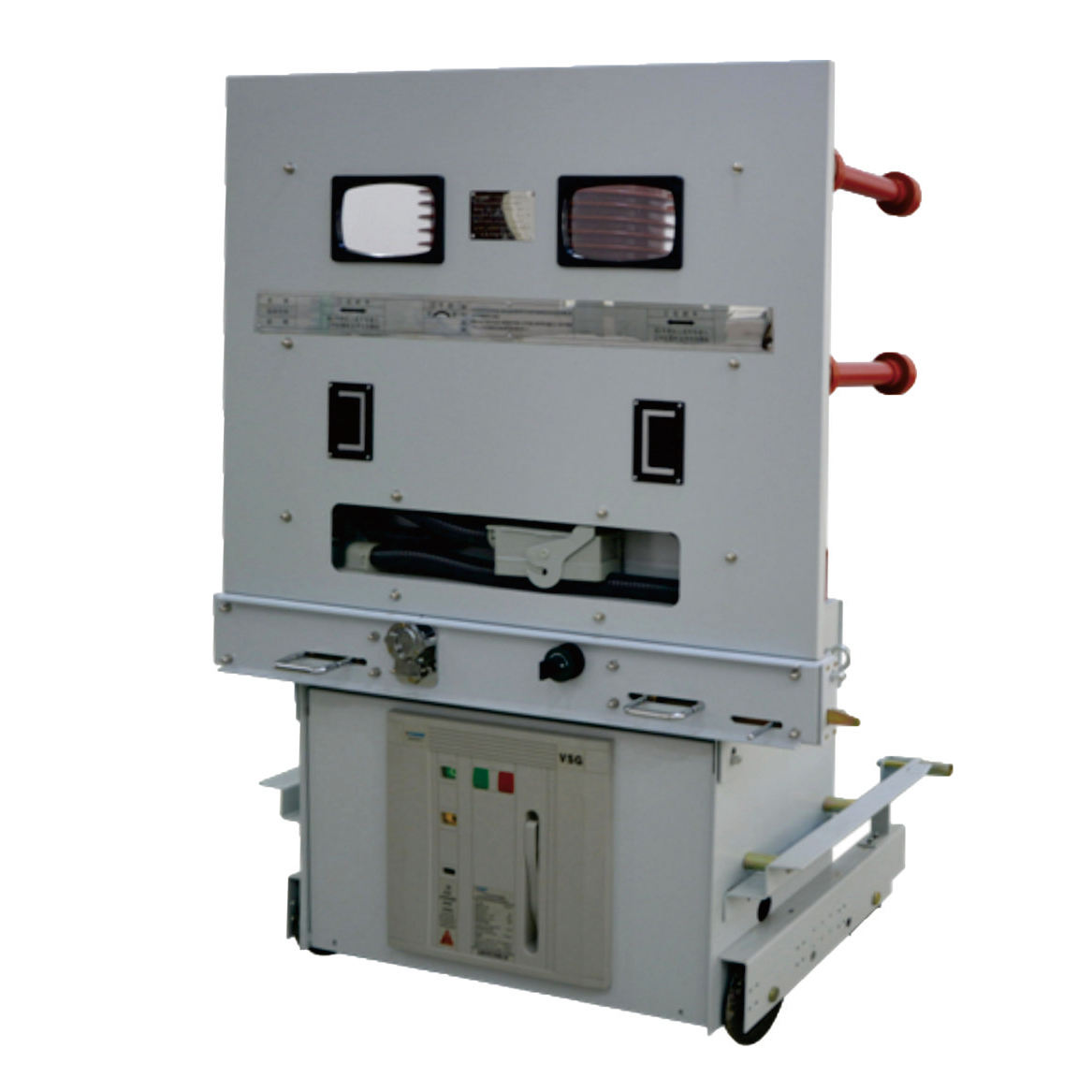
Inside a modern protection scheme, the trip path begins long before any visible disturbance. Current transformers continuously sample phase currents and feed scaled replicas into the relay's analog front end. The relay runs a dedicated overcurrent algorithm—often based on true RMS or instantaneous peak detection—and compares the measured value against a preconfigured pickup threshold. Once the threshold is exceeded, a pickup flag is set, but the logic does not act blindly. It checks the time-current characteristic, deliberate delay settings, and sometimes directional or harmonic restraints to distinguish a genuine fault from a transient inrush.
When the trip decision is finalized, the relay energizes its output contact or sends a high-speed trip signal over a communication-assisted scheme. For electromechanical or vacuum circuit breakers, the trip coil releases stored mechanical energy, causing the main contacts to part. Arcing between the separating contacts is managed by arc chutes or vacuum interrupters, which cool and extinguish the arc within a few milliseconds. The entire sequence—from the first overcurrent sample to complete galvanic isolation—can be executed in 30 to 80 milliseconds, depending on breaker technology and relay processing speed.
This speed is not accidental. It is the product of coordinated settings, where upstream and downstream devices are tuned so the nearest breaker clears the fault while others remain closed. Each relay's time-overcurrent curve is selected to provide both sensitivity and selectivity, ensuring that a fault on one feeder does not darken an entire substation. In critical installations, additional logic such as zone-selective interlocking or arc-flash detection can trim the isolation time even further, limiting both equipment stress and incident energy.
Why Spring-Charged Mechanisms Outperform Manual Operation in Emergency Scenarios
In an emergency, the difference between a spring-charged mechanism and a manual operation is often measured in fractions of a second. Manual mechanisms rely on human speed, presence of mind, and physical capability—all of which degrade under stress. A spring-charged system, by contrast, stores energy in advance and releases it instantly when triggered, bypassing the variability of human reaction. This means that even in chaotic conditions, the mechanism completes its action with consistent force and timing, reducing the risk of partial engagement or incomplete operation that can occur when someone fumbles with a lever or handle.
Beyond speed, spring-charged designs offer a level of repeatability that manual operation cannot match. Every activation draws on the same preloaded energy, so the output is predictable regardless of who initiates it or how tired they are. In emergency scenarios where multiple devices may need to be actuated rapidly, this uniformity ensures that each unit performs identically, preventing the cascade of failures that can happen when one manual action is weaker or slower than another. The mechanism does not get exhausted, does not panic, and does not require fine motor skills that may be compromised by adrenaline or injury.
Finally, spring-charged mechanisms eliminate the dependency on operator training and physical strength. In a crisis, the person nearest to the device might be untrained or physically impaired; a manual system would demand both knowledge and force, creating a bottleneck. A spring-charged design only requires a simple trigger—often a button, pull ring, or break-glass element—that can be activated by almost anyone. This democratization of emergency response means that critical actions are not delayed by the need to find a qualified operator, making the overall system far more resilient when every second counts.
Smart Monitoring Features That Turn a Basic Breaker into a Predictive Maintenance Tool
A basic breaker waits for a fault to happen. Add smart monitoring and it starts paying attention to the small stuff—tiny temperature rises on a lug, occasional voltage sags, or a slight change in current draw that doesn't trip anything yet. These signals often point to loose connections, worn contacts, or failing insulation long before they cause an outage. By tracking them continuously, the breaker becomes an early warning system instead of a last line of defense.
The real difference comes from the ability to store and compare data over time. Instead of a technician taking a spot reading every few months, the breaker keeps a running history of load patterns, harmonic distortion, and trip events. Maintenance teams can set thresholds for specific anomalies, receive alerts when a trend crosses a boundary, and pull up historical waveforms to pinpoint when a problem started. This turns scheduled maintenance into condition-based work—no more guessing or replacing parts just because a calendar says so.
Predictive maintenance on a breaker also changes how facilities plan for downtime. A breaker that reports early signs of contact wear lets you order parts and schedule a short shutdown at a convenient time, rather than dealing with an unexpected failure during peak production. Over time, the data helps identify which circuits are chronically stressed, guiding upgrades before they become emergencies. The breaker stops being a passive component and starts acting like a sensor that protects the whole electrical system.
Common Misconceptions About Vacuum Circuit Breaker Lifespan and Contact Wear
Many operators assume a vacuum circuit breaker's lifespan is simply a fixed number of mechanical operations, like 10,000 or 30,000, and that contact wear progresses linearly with each trip. In practice, the actual duty cycle varies wildly depending on the interruption current, ambient temperature, and how often the breaker sits idle versus cycling under load. A unit that interrupts frequent low-current faults may outlast one that rarely operates but handles a few high-energy short circuits, because the arc energy and contact erosion are not proportional to the operation count alone.
Another persistent myth is that visible contact gap or shiny contact surfaces indicate good health. Vacuum interrupters are sealed, and internal contact wear cannot be judged from the outside without specialized testing. Even a contact that looks clean can have significant material loss or reduced contact force, leading to higher resistance and overheating. Relying on a visual inspection instead of a contact erosion indicator or a vacuum integrity test often gives a false sense of security until a failure occurs during a critical switching event.
Some maintenance teams also believe that replacing the vacuum interrupter automatically resets the breaker to a like-new condition, ignoring the mechanical linkage, springs, and operating mechanism. Worn bushings, weakened opening springs, or misaligned push rods can accelerate contact wear in a brand-new interrupter. A holistic approach that tracks both electrical wear (based on cumulative interrupted current) and mechanical wear (operations, lubrication, alignment) prevents the premature end-of-life surprises that come from treating the interrupter as the only consumable component.
How Utilities Are Using Automatic Vacuum Breakers to Stabilize Renewable-Heavy Grids
Grid operators once relied on slow mechanical breakers that could take several cycles to clear a fault. Automatic vacuum breakers change that equation by extinguishing arcs inside a sealed vacuum chamber, letting them interrupt fault currents in as little as two cycles. That speed matters when a cloud bank rolls over a solar farm or a wind gust drops off: the resulting voltage sag can trip sensitive equipment before conventional protection reacts.
What makes vacuum breakers practical for renewable-heavy systems is their ability to handle frequent operations without contact degradation. Unlike oil or air-blast breakers, they don't require regular replenishment of arc-quenching media and can cycle thousands of times with minimal wear. Utilities pair them with digital relays that monitor phase angles and frequency, automatically opening or closing the breaker to sectionalize a feeder, switch capacitor banks, or isolate an underperforming inverter cluster before instability spreads.
Some distribution utilities in the southwestern U.S. and parts of Europe have installed automatic vacuum breakers on solar-heavy feeders and substation bus-ties. When a large PV plant drops offline, the breaker isolates that segment in under 100 milliseconds, preventing the voltage dip from cascading into adjacent circuits. In a few cases, this fast sectionalizing has allowed operators to keep more renewable generation online during transient events instead of tripping entire substations, which directly cuts curtailment losses.
FAQ
The key difference lies in the operating mechanism. A conventional vacuum breaker often requires manual charging and local switching, while an automatic version includes motorized or solenoid actuators tied to protection relays and control systems. That lets it open or close on its own when preset conditions are met, without a person ever touching the breaker.
When the contacts separate, the arc is actually sustained by vaporized metal from the contact surfaces. Because the interrupter is sealed under high vacuum, there's almost no gas to ionize around that vapor. At the first current zero, the metal vapor condenses back onto the contacts almost instantly, and the dielectric strength recovers so quickly that the arc simply can't reignite.
Faults in medium-voltage systems escalate fast, and every extra cycle of arcing can damage equipment or widen an outage. Automatic operation means the breaker doesn't wait for a human to notice something's wrong. It clears the fault in milliseconds, which protects transformers, cables, and downstream gear, and often recloses automatically to restore service if the fault turns out to be temporary.
Typically, protection relays monitor current, voltage, and frequency. They can be set to trip on overcurrent, short circuit, earth fault, or undervoltage. In more advanced setups, the breaker also receives commands from a SCADA system or a local controller that considers data from temperature sensors, pressure switches, or load-shedding schemes.
You'll find them in industrial plants, utility substations, data centers, and renewable energy collector stations. Those sites can't afford long outages or risky manual switching. Vacuum interruption is clean, compact, and quiet, and the automatic functionality makes it easy to integrate into automated distribution or backup power systems.
For one thing, the vacuum interrupter is sealed, so there's no oil to leak or catch fire, and no exposed arc chute that can eject hot gases. For another, automatic tripping keeps operators away from energized equipment during a fault. The breaker acts faster than any human could, which reduces the chance of arc flash injury or equipment explosion.
The vacuum interrupters themselves are generally maintenance-free and can last for tens of thousands of operations. But the operating mechanism, charging motor, auxiliary contacts, and control wiring need periodic checks. You'd also want to verify the trip and close coil health, test the protection relay logic, and inspect any stored-energy capacitors or batteries that power automatic operations.
Most modern automatic vacuum circuit breakers come with built-in communication ports supporting protocols like IEC 61850 or Modbus. That means they can report status, fault records, and contact wear directly to a central system. Remote open and close commands are standard, and some even allow firmware updates or setting changes over the network.
Conclusion
Inside a vacuum interrupter, separating contacts create a metal vapor arc that quickly extinguishes as current approaches zero, because the high vacuum offers almost no ionized particles to sustain the arc. This gives the breaker its fast, reliable interruption ability. Meanwhile, the automatic trip logic continuously samples current through protective relays. When an overcurrent or short circuit is detected, a signal fires the trip coil within a few milliseconds, releasing stored energy in a spring-charged mechanism. That stored mechanical energy opens the contacts far faster and more consistently than a human operator ever could, which matters greatly in emergency scenarios where a delay of even one cycle can allow equipment damage or arc flash.
Beyond tripping, modern automatic vacuum circuit breakers carry embedded sensors for coil current, contact temperature, and mechanical timing. These feed analytics that spot wear trends long before failure, turning the breaker into a predictive maintenance asset rather than a replace-on-failure component. A common misconception is that vacuum bottles lose vacuum quickly or that contact wear always follows a simple linear curve. In reality, well-sealed interrupters can hold vacuum for decades, and contact erosion depends heavily on interruption duty and environmental factors, not just calendar age. Utilities are also discovering that these breakers help stabilize grids with high renewable penetration by clearing faults rapidly and allowing precise sectionalizing, which reduces the risk of cascading outages when wind or solar output shifts abruptly.
Contact Us
Contact Person: Kellen Chen
Email: [email protected]
Tel/WhatsApp: 8613806536768
Website: https://www.cnxiaopai.com