

Best Coconut Shell Activated Carbon: How to Choose the Right One for Cleaner Water and Air
2026-11-16
Not all coconut shell activated carbon is created equal. If you've ever wondered why some filters leave a faint taste while others make water crisp, the secret lies in the carbon's source and activation process. Choosing the right one for cleaner water and air doesn't have to be a guessing game—Tundrr has refined the selection criteria so you can breathe and drink with confidence. Let’s break down what actually matters before you buy.
The Real Reason Coconut Shell Carbon Outperforms Coal and Wood
Coconut shell carbon doesn’t win on marketing—it wins in the pore structure. While coal and wood both produce activated carbon, their internal architecture is far less controlled. Coal carries mineral inclusions that block the very pores you are trying to create, and wood tends to open up large, irregular channels that let small contaminants slip through. Coconut shell, by contrast, develops a dense network of micropores under 2 nanometers. That is exactly the size range needed to trap chlorine, volatile organics, and other low-molecular-weight impurities. The result is faster adsorption kinetics and a noticeably cleaner output, even at higher flow rates.
Then there’s the ash problem. Coal-based carbon often carries 8–20% ash, and wood isn’t much cleaner after activation. That ash doesn’t just sit there—it leaches into the water or air stream, shifts pH, and shortens the working life of the filter bed. Coconut shell carbon typically holds ash below 3%, which means fewer unwanted ions, less pH drift, and far less risk of secondary contamination. For anyone running a sensitive process, from dialysis water to aquarium systems, that difference is immediate and measurable.
Hardness is the third quiet advantage. Coconut shell carbon particles are dense and resist fracturing, so they don’t crumble into fines during backwashing or pressure swings. Coal-based carbon is brittle by comparison, and wood-based carbon is softer still. Those fines increase pressure drop and can coat downstream membranes or resin beds. Coconut shell’s durability keeps the bed intact longer, cuts replacement frequency, and lowers total operating cost—without needing a sustainability story to justify it.
Reading the Iodine Number Without Falling for Marketing Hype
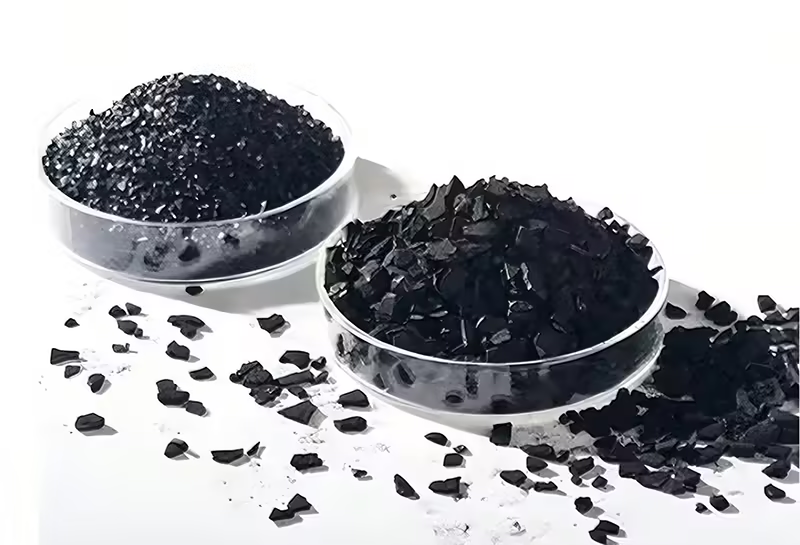
A high iodine number gets thrown around like a badge of honor, but it only tells you about adsorption capacity for small molecules—not overall performance. If your target contaminants are larger or the carbon's pore structure doesn't match the application, chasing a bigger number can lead to the wrong choice.
Look at the test context. Iodine number reflects micropore volume under specific lab conditions, not real-world contact time, pH, or competing organics. Two carbons with the same iodine value can behave very differently depending on raw material, activation method, and particle size.
Instead of treating it as a quality score, use iodine number as one data point. Ask for pore size distribution or a pilot test for your actual water or air stream. That is how you avoid paying extra for a spec that sounds impressive but does not solve your problem.
Why Hardness Determines If Your Filter Lasts or Leaks Fines
Hardness isn't just a spec on a data sheet—it's the quiet referee deciding whether your filter media holds its shape or slowly gives way under pressure. Soft filter materials, even those with fine pore ratings at the start, tend to deform under cyclic loading. That deformation opens micro-channels around the sealing edges and inside the media bed, letting fines sneak past where they never should. A harder filter element resists this compaction and surface wear, keeping the tortuous paths intact far longer.
The failure rarely announces itself. You'll notice a gradual uptick in downstream particle counts, or a slight drop in differential pressure that suggests flow is finding an easier route—usually around, not through, the filter. That's the hallmark of hardness-related leakage. Harder materials also shed less of their own structure into the process stream, which matters when the fines you're trying to catch are chemically similar to the filter itself. Softer media can erode at the high-velocity inlet zones, adding to the very contamination you're fighting.
In practice, matching hardness to your operating envelope means looking beyond the initial efficiency rating. Cyclic temperature swings, flow surges, and backpulsing all hammer the filter structure. A material that's just hard enough at room temperature may lose that edge when thermal expansion and mechanical fatigue team up. The filters that last are the ones whose hardness stays stable under your worst-case conditions, not your best-case spec sheet numbers.
Matching Micropores to the Chemicals You Actually Want Gone
A carbon filter with a random spread of pore sizes will pull some things out of the air or water, but it rarely does the job you bought it for. The catch is that adsorption happens at the molecular level: a pore only traps a molecule if the two fit closely enough for van der Waals forces to grab hold. Oversized pores let the target slip through, undersized ones block it entirely, and the middle ground is where the real work happens. Matching micropore width to the kinetic diameter of a specific chemical turns a general-purpose material into a selective trap.
Take formaldehyde and toluene as examples. Formaldehyde is small and polar, moving fast through narrow ultramicropores below 0.7 nanometers. Toluene is larger, nonpolar, and needs pore widths closer to 0.8 to 1.2 nanometers to condense and stick. If you size the pores for one, the other may pass by untouched. This is why blending carbons with different pore distributions or choosing a substrate with a tight, known range can matter more than total surface area. The best result comes from knowing the exact contaminant list, not chasing a higher iodine number.
Real-world performance also depends on what else is in the stream. Humidity, competing volatile organics, and temperature all shift how well a given pore size works. A material tuned for benzene under dry lab conditions may lose most of its capacity in a humid bathroom or a solvent-heavy workspace. So the practical approach is to test the sorbent against the actual mixture you want cleaned, then adjust the pore structure accordingly. When the pore geometry lines up with the molecule you are after, the filter stops being a vague black box and starts acting like a designed part.
The Certifications Worth Checking Before You Pay
A shiny badge on a website doesn't always mean a product has been independently tested. Some logos are simply marketing graphics, while others represent actual third-party audits or lab results. Before you hand over your credit card, it's worth spending a few minutes verifying those certification claims directly on the issuing organization's site. Look for a certificate number or a searchable database entry—if the brand can't provide a way to cross-check, that's a red flag.
Different product categories lean on different standards. For organic food, the USDA Organic seal means the farm and handling facility passed an annual inspection. For electronics, UL or ETL marks indicate the device met safety requirements for electrical shock and fire hazards. In textiles, OEKO-TEX or GOTS certification can tell you whether harmful chemicals were restricted during production. Knowing which certification actually applies to what you're buying prevents you from being swayed by a generic "eco-friendly" or "lab tested" claim.
Also pay attention to whether the certification covers the entire product or just one component. A mattress might tout CertiPUR-US foam, but that only certifies the foam layer, not the cover or adhesives. Similarly, a supplement bottle might display a USP or NSF mark, yet the actual ingredient list may still include fillers you'd rather avoid. Checking the scope of the certification—and how recently it was issued—gives you a clearer picture than any marketing copy ever will.
Signs You're About to Buy Carbon That's Already Spent
When a deal looks too good, the first red flag is usually a missing or mismatched serial number. Every legitimate carbon credit carries a unique identifier tied to a public registry. If the seller can't produce that number right away, or the digits don't line up with any active record, you're likely holding a certificate that someone else has already retired.
Another tell is vagueness about the project itself. If the seller hesitates to name the exact project, vintage year, or verification standard, that's a problem. Credits that have already been spent often get copied and resold without a clear chain of custody. Always ask for the retirement record. If they can't prove the credit is still active, the carbon is gone.
Watch for pressure tactics and prices that seem suspiciously low. Credits that are already retired or double counted tend to get dumped cheap just to move them fast. Legitimate credits come with a traceable path from issuance to your account. If any link in that chain is missing, or the seller simply says "trust me," don't buy it.
FAQ
Coconut shell carbon typically has a higher proportion of micropores, which makes it especially effective at trapping small organic contaminants and chlorine byproducts. It also tends to be harder and less dusty, so you get less fines rinsing out during initial use.
Iodine number reflects the total surface area available for adsorption, mostly in micropores. For drinking water, look for at least 900 mg/g; for air and vapor removal, 1000 mg/g or higher usually indicates a more active material with better capacity.
If the carbon will contact drinking water or beverages, acid washing is worth it. It removes water-soluble ash and reduces pH spikes, so your filtered water won't come out with a metallic taste or unusually high pH during the first few liters.
Not necessarily. Finer mesh like 12x40 works well for point-of-use water cartridges because it balances flow restriction with contact time. For whole-house tanks with backwashing, a larger mesh such as 8x30 reduces pressure drop and channeling.
It can, but you'll get better results if you match the carbon to the job. Air applications often benefit from carbon that is not saturated with moisture and may need more macroporosity for volatile organic compounds, while water treatment leans heavily on micropore volume.
CTC measures the carbon's ability to adsorb larger molecules through mesopores, which matters for removing color bodies, larger organics, and some solvents. A good balance of iodine and CTC values means the carbon isn't only microporous and can handle a wider range of contaminants.
Taste, odor, or chlorine breakthrough is the most practical signal. Most household cartridges last 3 to 6 months, but if you notice the filtered water developing a slight chemical or earthy note before that, the adsorption sites are likely exhausted.
Conclusion
Coconut shell carbon earns its reputation because the raw material starts with a naturally tight, high-density pore structure that coal and wood simply cannot match. That means more surface area in the micropore range where volatile organic compounds, chlorine byproducts, and low-molecular-weight odors actually get trapped. But a high iodine number alone is not a guarantee of quality—some sellers inflate that figure with blends or post-treatments that do nothing for your tap water. Instead, look at two physical properties together: iodine number should be backed up by a high hardness value. Soft carbon crumbles, sheds fines, and clogs pre-filters fast, turning a bargain cartridge into a maintenance headache. Hard, dense granules hold their shape through backwashing and pressure swings, which keeps the filter bed clean and long-lived.
Beyond the numbers, match the pore distribution to the chemicals you actually want gone. If you are dealing with chlorine taste and common disinfection byproducts, a predominantly microporous coconut carbon works well. For larger molecules like some pesticides or color bodies, you may need a blend with more mesopores—ask for a pore-size curve rather than a single BET value. Before paying, check for NSF/ANSI 42 or 61 certification, or at least an independent lab report for the specific contaminants you care about; a generic “food grade” claim is not enough. Finally, watch for spent carbon being resold as fresh: if the product smells dusty, looks overly dry and crumbly, or arrives without batch-specific adsorption data, walk away. Real fresh coconut carbon has a slight clean, almost neutral odor, feels firm between your fingers, and performs consistently from the first liter to the last.
Contact Us
Contact Person: Ellen Zhang
Email: [email protected]
Tel/WhatsApp: +86(21) 2287 6756
Website: https://www.tundrr.com/en/