

Best Shock Absorber Jounce Bumper Choices for a Smoother Ride
2026-11-16
Most drivers fixate on springs and shock absorbers, then wonder why rough pavement still sends a sharp jolt through the cabin. The missing piece is often the jounce bumper—a small component that does an outsized job of absorbing impact before the suspension bottoms out. But not all bumpers are equal. Some collapse too early, others feel rock-hard. The choices below focus on materials, shape, and durability, with XIAYI standing out for consistent compression and a smoother ride.
The Abrupt Stop You Only Notice on Square-Edged Bumps
Square-edged bumps do not roll under a tire the way a rounded speed hump does. They present a near-vertical face, and the suspension has only a fraction of a second to absorb the hit. That is where the abrupt stop shows up—not as a loud bang, but as a brief, hard interruption in the cabin, the kind that makes you glance at the road even when you already knew the bump was there.
The sensation has less to do with raw speed and more to do with how little the tire can climb before impact. On a rounded profile, the wheel starts moving upward early and spreads the force across a longer arc. On a square edge, that lead-in is missing. The wheel meets the lip almost flat, so the energy arrives in one short spike. You feel it through the seat and the steering column more than you hear it.
What makes the stop feel odd is how quiet it seems afterward. There is no long shudder or bouncing, just a single firm jolt that vanishes as quickly as it came. That brevity is easy to underestimate until you drive the same section repeatedly and notice how much attention your body starts paying to the edge before the car even reaches it.
Matching the Bumper's Ramp-Up to Your Spring Rate
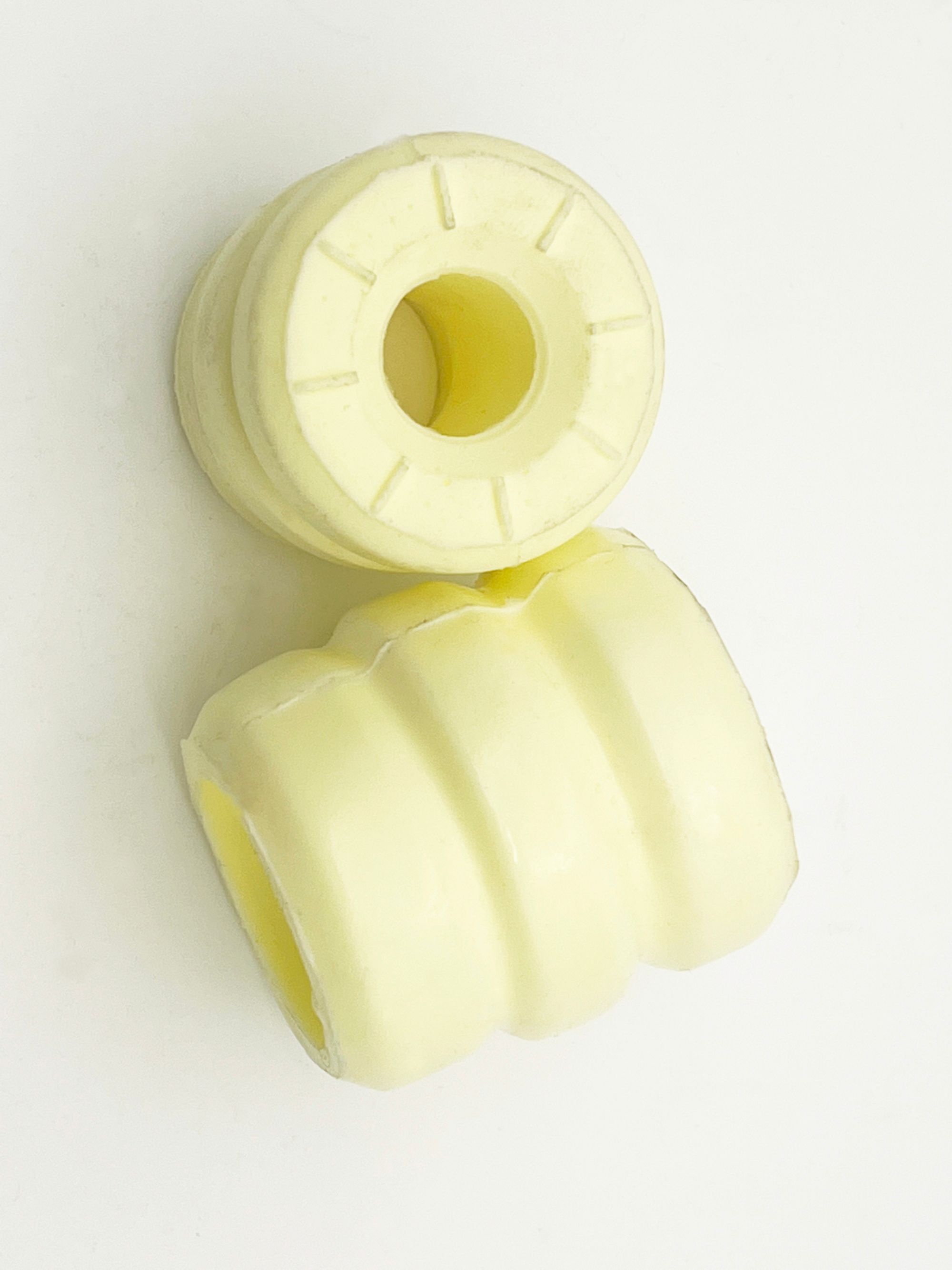
A bump stop never works in isolation. Its ramp-up is really the final portion of your effective spring curve, so the point where it starts to load matters just as much as the durometer or length. If the stop engages too early, the front or rear axle suddenly picks up a large amount of rate mid-corner, which usually shows up as a loss of grip and a nervous, skittish feel. Leave it too late and you give away the bottom-out protection you actually need on big hits.
Start by noting how much wheel travel you are actually using at the shaft, then work out roughly how far the suspension compresses before the bump stop makes contact. A softer main spring will use more travel for a given load, so it often needs a longer, more progressive stop that begins working gently. A stiffer spring setup can get away with a shorter, firmer stop because the main spring is already doing more of the work before the stop ever comes into play.
The useful test is not just whether the car bottoms, but how often the bump stop is being touched. A zip tie on the damper shaft makes this easy to check. If the zip tie gets pushed deep into the stop on every small ripple during normal driving, the initial ramp-up is too aggressive or the stop is too long for that spring rate. Shimming or trimming the stop changes the contact point without changing the main spring, and it is often enough to bring the transition back into a range the tire can manage.
Why Harder Polyurethane Isn't Always the Upgrade It Sounds Like
A harder polyurethane compound often gets treated like a straightforward durability upgrade, but that assumption falls apart once you look at how the material actually behaves under load. Increased hardness typically means a higher durometer rating, and while that can improve resistance to abrasion in certain sliding or scraping conditions, it also makes the part less able to absorb shock, flex with mating surfaces, or recover cleanly from repeated impacts. In applications like suspension bushings, caster wheels, or vibration isolators, that trade-off can lead to premature cracking, surface chipping, and more noise rather than a longer service life.
The problem is that hardness and toughness are not the same property. A very firm polyurethane may resist a sharp object digging into it, yet it can still tear at a cut edge or fail when forced to bend repeatedly because it lacks the elongation and energy return of a slightly softer formulation. Many engineers find that dropping down one or two durometer steps allows the part to distribute stress more evenly, which reduces localized heat buildup and the kind of brittle failure that gets mistaken for a bad batch of material.
There is also a comfort and fit dimension that gets overlooked. Seals, rollers, and pad components that feel like an upgrade on paper can end up transferring more vibration into the surrounding structure, causing wear elsewhere or making equipment unpleasant to operate. Rather than assuming the highest durometer available is the best choice, it usually makes more sense to match the polyurethane to the specific load, speed, and surface conditions the part will actually see.
Cut-to-Fit Urethane Stops and the Mistakes That Follow
Most off-the-shelf urethane stops don't land exactly where the press or fixture needs them, so a cut-to-fit block becomes the easy fix. A bandsaw or a sharp blade makes quick work of the material, but a simple trim alters how the stop meets the load.
The first failure usually starts at a rough, slightly tapered edge. That edge digs into the mating plate instead of sitting flat, and point loading tears the urethane at the corner within a few hundred cycles. Just as often, the original radius or chamfer disappears at the saw line, leaving a squared-off profile that concentrates stress right where the stop flexes—so the part splits well before its rated life.
A better cut keeps blade speed low, removes only what the fit requires, and finishes the edge with a light sanding or fresh chamfer. After the cut, the mounting face matters more than the overall length. If the stop leans or sits proud on one side, no amount of bolt torque will keep it from walking under load.
Getting the Gap Right Before the Suspension Runs Out of Travel
Setting the correct gap before the suspension bottoms out is less about chasing a perfect measurement and more about reading the terrain, your speed, and the bike's behavior as a single system. Riders often mistake a harsh landing for a tuning problem when the real culprit is that the fork or shock has already used up its stroke. The goal is to keep a small reserve of travel in hand, so the suspension never slams into its physical limit. This means checking sag under realistic riding conditions, not just in the garage, and making small adjustments to preload or air pressure until hard hits feel firm but never abrupt.
Instead of aiming for a generic percentage of unused travel, pay attention to how often you feel a sharp spike through the bars or saddle. That spike usually signals the suspension has reached the end of its stroke. If it happens only on the biggest impacts, you are close to the right setting. If it happens on moderate bumps, you need to increase spring rate, add compression damping, or reduce the time the suspension spends deep in its travel. Some riders run a zip tie on a fork stanchion or a rubber ring on a shock shaft to see exactly how much travel remains after a rough section, which gives a far more honest picture than guessing from feel alone.
Temperature, altitude, and even how much gear you carry can shift that remaining gap throughout a ride. A setting that leaves a comfortable margin in the morning may be completely used up by the afternoon as the suspension heats up and oil thins. For this reason, the gap before bottom-out should be rechecked periodically, especially during long descents or after changing terrain. Rather than treating the setting as a one-time task, think of it as a moving target that responds to your pace, line choice, and the bike's changing condition. A well-tuned reserve keeps the ride composed and gives you the confidence to push harder without worrying about a sudden, jarring stop.
Combining Softer Initial Contact with Firmer Bottom-Out Control
Softer initial contact does not mean the whole stroke turns vague. The first few millimetres of travel stay open enough to dissolve gravel chatter, small roots and worn pavement before the rider registers them. The payoff for that early plushness has to be managed later, though. A lazy tune would let the travel disappear too quickly and end with a harsh clank at the stops. Instead, the damping force and spring ramp climb sharply once the suspension moves past mid-stroke, so the final portion of travel feels like a taut cushion rather than a hard wall.
That split personality is what keeps the ride settled. The softer opening lets the wheel float over washboard and broken edges without transmitting vibration through the bars or seat. The firmer finish gives a clear sense of support when landing deep or hitting a square edge at speed, holding the chassis up instead of collapsing through the last bit of travel. It is not about setting one adjuster fully soft and another fully stiff; the handoff between the two zones has to be gradual enough that the increase in resistance arrives as a push, not a step.
When the balance is right, the suspension seems to read the ground ahead. Small chatter evaporates, big compressions are caught with a controlled end stroke, and the bike stays composed instead of pitching forward. The result feels less like a compromise and more like two separate circuits working in sequence: early compliance for texture, late authority for bottom-out control.
FAQ
It works as a secondary cushion near the end of suspension travel. Once the shock is almost fully compressed, the bumper absorbs the remaining force so metal parts don't smash together. That keeps potholes and speed bumps from turning into a sharp impact in the cabin.
Check the bumper on the shock shaft for crumbling edges, deep splits, or pieces that have broken off. You may also notice a hard clunk when the suspension droops into a dip or a harsher bottom-out on bigger bumps even though the shocks still feel controlled.
In many cases yes, especially if you drive on rough roads or regularly carry heavier loads. A quality microcellular polyurethane bumper can engage a bit earlier and build resistance progressively, reducing bottom-outs and body movement without making small bumps feel firm.
Microcellular polyurethane is a solid all-around option because it resists cracking and compresses gradually under load. Rubber tends to stay quieter at first contact but can harden over time. Cheap solid foam or plastic pieces usually collapse too quickly and offer little real protection.
Yes, they can. If the bumper is overly firm, the last portion of suspension travel feels abrupt, especially on sharp-edged bumps. The better choice is a bumper that engages early enough to control dive and roll, but still builds force gradually instead of acting like a hard stop.
Usually, though the process varies by vehicle. Some designs let you slide a split bumper over the shaft, while others require removing the shock and compressing the spring to reach the factory bumper. A quick look at the service manual will tell you which setup you have before ordering parts.
You should notice fewer harsh bottom-outs on broken pavement, less rear squat when accelerating with passengers or cargo, and calmer body motion over dipping curves. The change is subtle on smooth highways but becomes clearer on rough streets and loaded trips.
Conclusion
Most drivers never think about a jounce bumper until a square-edged pothole sends a hard clank through the chassis. That abrupt stop is rarely just a tired damper; it's often the bumper doing too much too early, or a free gap wide enough that the suspension hits the stop at speed. Getting that gap right matters before travel runs out, because once the stop becomes the spring, the force curve changes instantly. A smarter move is to match the bumper's ramp-up to the actual spring rate instead of grabbing whatever polyurethane cone happens to fit. Cut-to-fit urethane stops can work, but they invite trouble: uneven cuts, a progressive rate that starts too high, or trimming so much that the last part of travel goes unprotected.
Harder polyurethane is easy to mistake for an upgrade, yet it often adds small-bump harshness while giving a false sense of bottom-out control. What tends to work better is a stop with softer initial contact that still firms up near the end of travel, so the suspension eases into the bumper instead of slamming against it. That balance keeps composure on broken pavement and still prevents the metal-to-metal clank when the suspension really compresses. The real aim is a predictable handoff from spring to bumper, with the ramp-up shaped to the vehicle rather than picked by color or durometer alone.
Contact Us
Contact Person: Leela
Email: [email protected]
Tel/WhatsApp: 8613586885132
Website: https://www.xiayishockparts.com