

CNC Press Brake Company Selection Tips for Precision Metal Fabrication
2026-09-22
Choosing the right CNC press brake partner can make or break your precision metal fabrication workflow. A machine that drifts out of tolerance or a vendor that vanishes after installation isn't just a nuisance—it's a direct hit to your bottom line. Before you sign off on a supplier, you need to know what separates a dependable shop from one that will leave you chasing microns. That's why HUNSONE put together this guide: practical, no-fluff criteria to help you evaluate CNC press brake companies and keep every bend exactly where it belongs.
Match the Press Brake to Your Thickest Material First
When a shop takes on a new press brake, the temptation is to look at maximum bed length or stroke first. But the real decision point hides in the thickest sheet or plate you expect to form. That single number sets the tonnage ceiling, the minimum die opening, and the bend radius you can actually hold without cracking the edge.
A brake rated for 1/4 inch mild steel may handle the occasional 3/8 inch piece only if the die opening is wide enough and the bend length is short. If your thickest job runs full length across the bed, you need to work backward from that worst case. Otherwise, you end up forcing the ram, overloading the frame, or settling for a radius that no drawing ever called for.
It is cheaper to buy a little extra tonnage up front than to split thick jobs into narrow sections or reject parts because the flange won't sit flat. Look at the material grade too: high-strength plate can demand nearly twice the force of plain carbon steel at the same thickness. Once the thickest job is covered, lighter gauges are rarely a problem.
Ask About Backgauge Repeatability Under Full Load
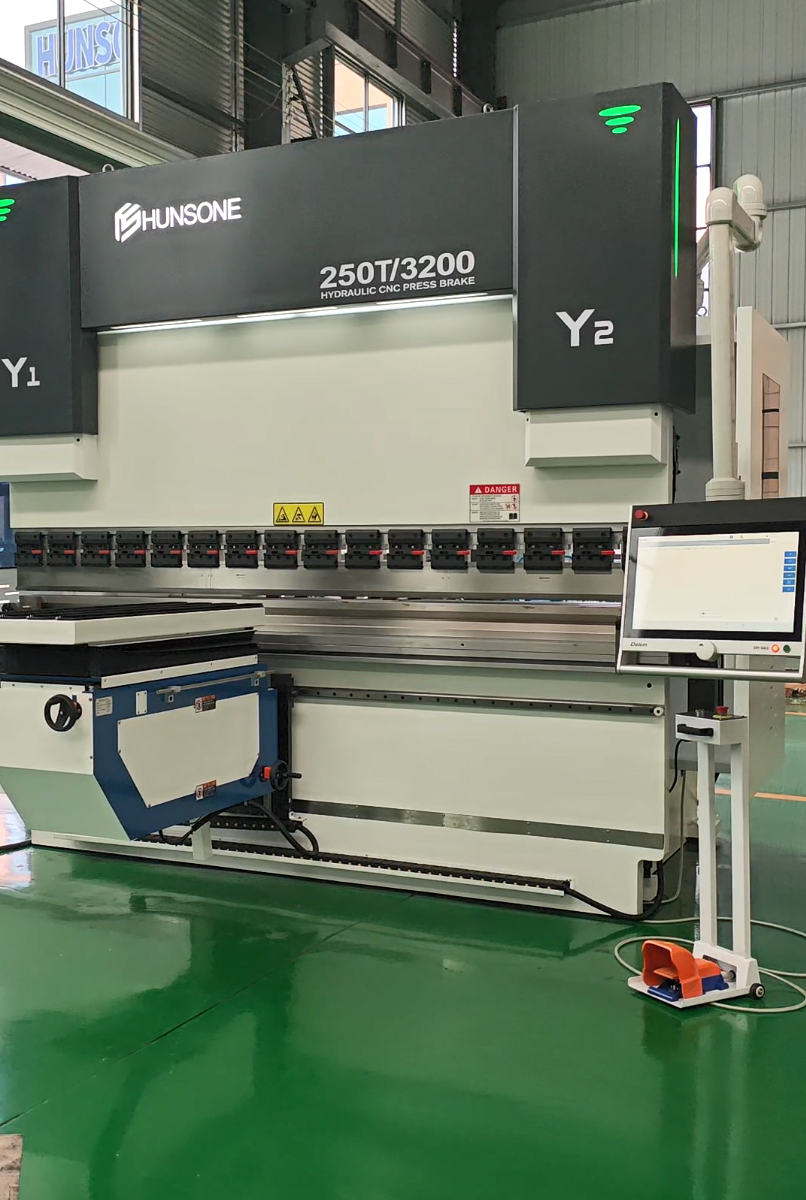
Backgauge repeatability under full load is not a static number—it changes once the frame flexes, the ram applies tonnage, and the tooling seats. When you ask about this spec, press for how the measurement was taken: was it a dry cycle with no material, or a sustained run at the machine's rated capacity? A reliable builder will describe the test setup, including load percentage, sheet thickness, and whether the backgauge was measured over dozens of cycles or just a handful.
What to listen for in the answer is specific, not vague reassurance. Ask if the control compensates for frame deflection, how the backgauge guides are preloaded, and what happens to repeatability after the hydraulic system reaches operating temperature. If the answer stays general or leans only on a catalog value, treat that as a red flag. Real repeatability under load shows up in the tolerance holding across a full shift, not in a single lab test.
Local Service Response Beats a Lower Sticker Price
When a furnace dies on a January night, the last thing anyone wants is a recorded message from a discount contractor three towns over. A local outfit that picks up the phone, shows up within the hour, and has the part on the truck saves more than money—it saves a frozen weekend. That kind of response turns a cheaper bid into false economy the moment you’re left waiting.
Price tags don’t cover the cost of uncertainty. A lower sticker price often means a stretched schedule, a subcontractor you’ve never met, or a callback that goes unanswered. Local providers live and die by their reputation in the neighborhood. They aren’t chasing volume; they’re protecting repeat business and word-of-mouth, which means they tend to answer when you call and stand behind the work when something slips.
None of this dismisses the appeal of saving a few hundred dollars upfront. But when the choice is between a slightly cheaper invoice and a crew that treats your emergency like an emergency, the real bargain is usually the one that shows up.
Verify Tonnage With a Real Test Bend
There is only so much a tonnage chart or a quick formula can tell you before the metal starts talking back. A real test bend strips away the guesswork because it accounts for the quirks of your specific press, the exact alloy temper you pulled off the shelf, and how the tooling has worn since last Tuesday. When you run an actual piece of material through the brake, you are not just checking a number; you are listening to the machine grunt, feeling the ram hesitate, and watching the bend line form without tearing or undesired springback.
Start with a scrap piece cut from the same lot as your production run, then dial the press down to roughly eighty percent of the calculated tonnage and make a slow, deliberate bend. If the angle comes up short or the material fights you, creep the pressure upward in small increments until the bend settles into the target angle with a crisp, even profile. Pay attention to how the ram sounds under load — a sharp, metallic complaint often means you are pushing too hard, while a soft, steady push usually signals a clean bend.
Once you find the tonnage that produces a good bend on the test piece, write it down along with the exact material thickness, die opening, and grain direction. Then run a second test piece to confirm the result is repeatable, not just a lucky strike. This real-world verification gives you a baseline you can trust when the next batch of sheet metal arrives from the mill with a slightly different temper, or when the night shift swaps in a freshly sharpened punch.
The Demo Part That Reveals Hidden Weaknesses
Most product demos are curated to the point of illusion. The real value surfaces when someone asks an unscripted question or tries a workflow that wasn't rehearsed. That's exactly where hidden weaknesses show up: a dropdown that doesn't repopulate after filtering, a file upload that stalls on larger assets, or a permissions setting that quietly blocks a secondary user. These aren't edge cases in the traditional sense; they're the gaps between the happy path and actual use.
The demo part that reveals hidden weaknesses often feels uncomfortable because it interrupts the narrative. Instead of glossing over it, treat that moment as diagnostic. If the product can't recover from a bad input or fails to sync across two browser tabs, that's not a presentation flaw—it's a signal about state management, error handling, or API design. Watching where the presenter hesitates tells you more than any slide deck.
A useful exercise is to deliberately run a demo with no script and let the audience choose the next action. The cracks that appear will cluster around integration points and boundary conditions. Fixing those before the next external-facing session turns a fragile walkthrough into something that holds up under scrutiny.
Compare Tooling Changeover Time, Not Just Bending Speed
Most shops get hypnotized by the cycle time of a press brake—how fast the ram drops, how quickly it returns. That number looks impressive on a spec sheet, but it rarely reflects real production. The moment you stop bending and start switching punches, dies, or entire setups, the clock keeps running. A machine that bends 20% faster yet needs 45 minutes for a tooling changeover can easily lose to a slower brake that swaps tools in under ten minutes. If you only compare raw bending speed, you’re comparing the highlight reel, not the whole game.
Tooling changeover time hits harder in high-mix, low-volume environments where you might switch jobs three or four times a shift. Every minute spent loosening clamps, aligning segmented dies, or hunting for the right punch eats directly into billable hours. Some modern systems use hydraulic clamping and front-loading tool holders to cut changeovers to a few minutes, while older styles still rely on manual bolts and trial-and-error alignment. Before you upgrade, time a full setup from last good part to first good part of the next job—not just the bending sequence.
A practical comparison should weigh total uptime across a typical week. Multiply the number of changeovers by the time each one takes, then factor in scrapped parts from misaligned tooling. You may discover that a mid-speed press with quick-change tooling outperforms a high-speed model with slow setups by a wide margin. When you sit down with vendors, ask for a timed demo that includes a complete tool swap, not just a rapid-fire bending run. That’s where the real productivity difference hides.
FAQ
Check their track record with tight-tolerance jobs, not just the machine specs. Ask for sample parts or references from shops doing similar gauge and bend complexity. A builder that asks about your material variance and tooling setup before quoting is usually a better bet than one that leads with horsepower.
More than most people admit. For precision fabrication, a rigid back gauge with repeatable positioning cuts setup time and reduces scrap. Look for machines where the back gauge axes are driven independently and can be fine-tuned in small increments. If the builder cannot explain the control resolution, walk away.
Local support often beats brand prestige when something goes wrong. A nearby supplier with stocked spare parts and a technician who can be on-site within a day can save a week of downtime. But do not ignore international brands if they have a strong regional service network. Ask for three recent local customer contacts and call them.
Ask how the control handles angle correction, material springback, and offline programming. A good test is to bring a sample drawing and ask the sales engineer to walk through setup on the floor. If they cannot demonstrate a bend sequence change in under a minute, the control is likely too clunky for high-mix work.
Bring a list of your current punches and dies, including heights and tang styles. Ask the company to confirm which existing tooling will fit without modification and which will need adapters. Also ask about quick-change clamping systems. If they push you toward proprietary tooling only, factor that cost into the total price.
For typical 16-gauge stainless, expect repeatability around plus or minus 0.002 to 0.004 inch on the flange length with a well-maintained machine and proper tooling. If a salesperson promises tighter than that across all materials and thicknesses without asking about your parts, treat it as a red flag.
Yes, because frame deflection directly affects bend accuracy. A heavier frame with a deep throat and minimal crowning requirements usually holds angles better over long runs. Ask about the frame's deflection compensation method, such as hydraulic crowning or shimming, and ask to see it in action on a long workpiece.
At minimum, they should provide installation, operator training, and a first-year calibration check. Look for companies that offer remote diagnostics and a clear response-time commitment in writing. Avoid anyone who treats training as a one-day box-ticking exercise. Precision work depends on operators understanding tooling setup and angle correction, not just pressing a foot pedal.
Conclusion
When narrowing down CNC press brake suppliers for precision sheet metal work, many shops start by comparing tonnage charts and advertised speeds, but that approach overlooks the real constraints on the floor. A better first step is to confirm the machine can handle your thickest material at the full bend length, not just a narrow center load. Some builders quote capacity based on ideal setups that fall apart once you load a full-width die. Along with that, ask for a live demonstration of backgauge repeatability under full tonnage; a gauge that drifts a few thousandths on a demo bench may wander far more when the frame flexes at maximum pressure. If you cannot get that data in writing, walk away. Another factor that often gets pushed aside is local service. A lower sticker price means little when a control fault stops production for three days while a technician flies in from another region. The shops that stay competitive in tight-tolerance bending tend to pick suppliers who can put a trained technician in their facility within a day or two.
Beyond the spec sheet, there are practical checks that expose weaknesses before purchase. Request a test bend on your own material, at the full width and thickness you actually run, and measure the angle variation from end to end. If the supplier hesitates to run your part or offers only a small sample, that hesitation is signal. The demo part itself is revealing: a well-built press brake leaves clean, consistent flanges without excessive shimming or repeated corrections. If the technician has to tweak the program multiple times to get an acceptable result, that hidden setup time will reappear on every future job. Finally, compare tooling changeover time realistically. Fast bending cycle times mean little if operators spend twenty minutes swapping and aligning punches and dies between batches. Quick-clamp systems, front-loading tool holders, and stored tool libraries matter more for high-mix precision work than raw ram speed. The best choice is rarely the fastest machine or the cheapest quote; it is the one that matches your thickest material, holds tolerance under load, and can be serviced quickly by people who understand your shop's workflow.
Contact Us
Contact Person: James Chen
Email: [email protected]
Tel/WhatsApp: 86 13770803946
Website: https://www.hunsone.com/