
Motorcycle Parts Vertical Lift Plating Equipment Solutions for Superior Surface Finishing
2026-09-24
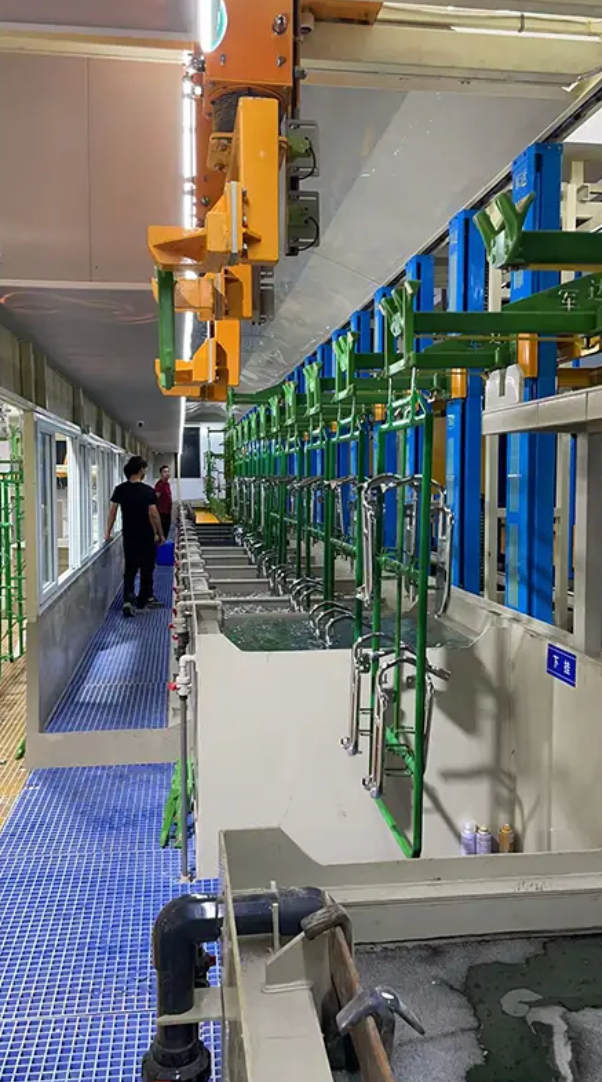
Why do some motorcycle finishes look flawless while others show uneven plating or rough spots? The answer often comes down to how parts are positioned and moved through the plating bath. Vertical lift equipment solves a persistent challenge: achieving uniform coating on complex shapes like brake calipers, triple clamps, and exhaust brackets. That’s where Junda comes in—our vertical lift plating solutions are built to deliver superior surface finishing with fewer rejects and faster cycle times. Read on to see how this technology can transform your production line.
Why Vertical Lift Systems Minimize Drip-Out on Motorcycle Frames
When a freshly coated motorcycle frame hangs horizontally, excess coating tends to pool in tube bends, gussets, and weld joints. A vertical lift changes that dynamic entirely. The frame rises straight out of the dip tank, so gravity works in line with the tube axes instead of against them. This pulls surplus material downward along the walls rather than trapping it in low spots.
The control of lift speed matters just as much as the orientation. A slow, steady vertical extraction gives the coating time to sheet off evenly while it is still fluid. At the bottom bracket, steering head, and rear axle plates, the extra liquid drains cleanly instead of forming teardrop-shaped drips. Many horizontal conveyor lines struggle here because the frame is essentially dragged through the air at an angle, leaving one side wetter than the other.
Vertical lift systems also reduce the need for post-coat touch-up. Since the frame exits the tank with the same orientation it will keep during curing, any remaining coating continues to migrate downward under heat. That means fewer paint sags, less hand sanding, and a more consistent film thickness across tubular sections. Motorcycle frame builders who switch to vertical lifting usually notice the improvement in the first production run, especially on models with intricate rear subframes.
Rack Fixtures That Prevent Shadowing on Cast Engine Covers
Cast engine covers rarely have a flat, simple shape. Deep ribs, mounting bosses, and recessed bolt pockets make it easy for a poorly designed rack to block the spray pattern or create a “shadow” where coating never lands. The most effective rack fixtures solve this by holding the cover at an angle that lets the coating stream reach into every crevice, rather than keeping the part perpendicular to the spray gun. That single change often eliminates the dull, thin patches that show up after curing.
Another approach is to shift contact points away from visible or corrosion-prone surfaces. Instead of clamping across a broad face, fixtures can use thin wire hooks or pin-style locators that grip only the inside of a bolt hole or the back edge of the cover. These minimal-contact designs leave the outer surface completely open to the coating flow, so there is no metal arm or bracket sitting between the nozzle and the part. For high-volume lines, fixtures are also built with quick-change brackets so operators can swap a worn or bent hook without tearing down the entire rack.
The payoff shows up downstream. When rack shadowing is eliminated, the coating thickness stays more uniform across the part, which means fewer rejects from thin coverage or exposed base metal. Rework drops, and the covers hold up better in salt spray and thermal cycling tests because there are no weak spots left by an obstructed spray path. It’s one of those quiet process improvements that doesn’t get much attention until you compare scrap rates before and after the change.
Achieving Uniform Chrome on Fork Tubes with Controlled Withdrawal
Uniform chrome thickness on fork tubes rarely comes down to the plating bath alone. Most variation starts the moment the part leaves the solution. Withdrawal speed, angle, and post-drip dwell all affect how much plating solution remains on the surface before rinsing. Tubes pulled too quickly trap excess solution near the bottom, while a slow, uneven lift can leave thin patches behind the seals and polished zones.
Controlled withdrawal means setting a repeatable lift rate—often between 10 and 30 mm per minute—and holding it through the entire exposed length. Slight vertical orientation, usually within one or two degrees of plumb, lets excess liquid sheet away without creating a heavy bead at the lower end. A short pause just above the bath surface, around 15 to 30 seconds, allows viscosity and surface tension to settle before the tube moves to the rinse station.
Small adjustments here outperform most chemical fixes because they act directly on the boundary layer. When the withdrawal speed is matched to the bath's viscosity and the tube's diameter, chrome deposits level out without extra polishing or masking. Older tanks with manual hoists can still hold tight tolerances if the operator marks lift zones clearly and resists the urge to hand-correct the speed mid-pull.
Reducing Wastewater Volume in Vertical Plating Lines
Vertical plating lines have traditionally consumed large amounts of rinse water because each process tank requires thorough cleaning between chemical steps. A practical way to cut wastewater volume is to rethink the rinse sequence itself. Instead of a single overflowing rinse after every bath, countercurrent rinsing uses two or three rinse tanks arranged so that fresh water enters only the final tank and flows backward toward the dirtier first rinse. This simple change can reduce water use by fifty to seventy percent without sacrificing cleaning quality, simply because the workpiece sees progressively cleaner water rather than a single diluted rinse.
Another overlooked opportunity lies in drag-out reduction. The more plating solution that clings to parts and racks as they leave a process tank, the more rinse water is needed to remove it. Slowing down withdrawal speed, allowing longer drainage time above the tank, and using air knives or drip trays can recover a significant portion of the process solution before rinsing even begins. This not only lowers wastewater volume but also returns valuable chemistry to the tank, cutting both treatment costs and chemical replenishment expenses.
For plants ready to go further, in-line recycling and closed-loop systems offer the greatest reduction. Technologies like ion exchange, reverse osmosis, and evaporation can purify rinse water and send it back to the same rinse station, drastically shrinking the amount sent to waste treatment. While the initial investment is higher, the long-term savings in water, sewer fees, and treatment chemicals often justify the cost, especially in regions with strict discharge limits or rising water tariffs.
Programming Hoist Schedules for Mixed-Part Motorcycle Runs
Setting up hoist schedules for mixed-part motorcycle runs starts with mapping each part family's process requirements. Different frame sizes, swingarm types, and bracket assemblies don't all need the same dip times or transfer speeds. When these parts share the same line, the schedule has to treat the hoist as a moving bottleneck instead of a fixed-interval transporter. Technicians typically define a base recipe per part number, then assign priority levels so that longer immersion steps don't stall lighter parts waiting behind them.
A practical approach is to build the schedule around virtual batches, grouping parts with similar process windows while still allowing single-piece flow where needed. The hoist controller can read part presence at each load station and insert moves on the fly, but this only works if the logic includes collision avoidance and empty-travel minimization. Many plants add buffer positions between stages so a late-arriving part doesn't force the hoist to dead-head across the entire line. Testing the schedule against recorded production data helps reveal patterns, like a particular mix of fuel tanks and fenders that consistently causes a queue at the e-coat rinse.
Once the basic sequence is stable, tuning comes down to small adjustments in hoist acceleration, pause-before-lower delays, and departure triggers. A good schedule doesn't just follow a fixed loop; it reacts to the actual mix on the line. Operators often keep a short list of alternate moves for low-volume parts that appear sporadically, so those parts don't force a full re-sort. Over time, the best hoist programs become a collection of rules rather than a single rigid timeline, allowing the line to handle mixed-part motorcycle runs without constant manual overrides.
Maintaining Anode-to-Cathode Spacing for Long-Term Consistency
Even a drift of a few hundred micrometers in the anode-to-cathode gap can alter local current density enough to create hot spots and uneven lithium plating. That kind of non-uniformity rarely announces itself early; it shows up months later as accelerated capacity fade or a sudden jump in internal resistance. Keeping the spacing fixed is not just a geometric concern, it is one of the quiet variables that decides whether a cell dies at 800 cycles or keeps running past 2,000.
Rigid separators alone are rarely sufficient because thermal expansion and electrode breathing work against them. A more practical approach combines materials with closely matched thermal expansion coefficients, a modest but controlled stack pressure, and current collectors stiff enough to resist creep without becoming brittle. Even the choice of tab placement and case wall thickness feeds into spacing stability—thin walls flex under pressure, and every flex translates into microscopic changes at the electrode interface.
Long-term consistency also requires detecting small shifts before they become irreversible. In research cells, in-situ pressure mapping and periodic electrochemical impedance spectroscopy can reveal early signs of gap widening or compression. On a production line, laser displacement checks after formation and after a few dozen cycles catch the outliers that will drift later. The goal is not to re-machine every stack but to identify which design tolerances actually control the gap over years of thermal cycling, not just on day one.
FAQ
It handles a wide range of components including brake discs, fork tubes, engine covers, handlebars, foot pegs, and fasteners. The adjustable rack design accommodates odd shapes and mixed batches without sacrificing access to recessed areas.
The vertical oscillation keeps solution moving through blind holes and recesses that horizontal barrels often miss. By lifting and lowering the rack, you get a more even current distribution, which reduces shadowing on parts like brake calipers or deep-drawn engine covers.
It supports zinc, nickel, chrome, and copper plating, as well as anodizing and conversion coatings. The tank layout can be configured for multi-stage processes, including cleaning, pickling, rinsing, and passivation, so you get a complete line in one footprint.
Both. The modular tank design lets you start with a basic manual line and add automation later. A small shop can run batch sizes from a few dozen pieces, while a larger facility can link multiple stations for continuous throughput.
The lift drive uses sealed linear bearings and a corrosion-resistant lead screw, so routine upkeep mainly involves checking the hoist cable or chain, greasing guide rails every 200 operating hours, and inspecting electrical connections near the tanks. No special tooling is needed.
Yes. Rack dimensions, tank depth, and lift stroke can be adjusted to fit parts like swingarms, frames, or exhaust headers. We often design custom fixtures with shielded contact points to prevent burning at high-current areas.
Barrel plating tends to tangle and dent small parts like spokes and bolts. Vertical lift racks hold each piece separately, which means less part-on-part damage and more consistent film thickness. For larger structural parts, barrels are often impossible, while vertical lift handles them directly.
The control panel includes emergency stop, low-level tank alarms, and ventilation interlocks. Fume extraction hoods along the tank line and a slip-resistant work platform help keep the workspace compliant with typical occupational health guidelines.
Conclusion
Vertical lift plating lines solve a persistent headache for motorcycle manufacturers: handling long, awkward frame sections and engine castings without the sagging, dripping, and uneven coverage that horizontal barrel or rack lines often produce. Because parts hang vertically and are withdrawn at controlled speeds, excess solution drains cleanly off frame tubes and fork tubes instead of pooling in crevices. This controlled withdrawal is especially critical on chrome-plated fork tubes, where a slight change in hoist speed can shift deposit thickness enough to cause visible banding. Rack fixtures designed with contact points on non-functional surfaces prevent shadowing on cast engine covers, allowing nickel and chrome to reach recessed cooling fins and bolt bosses without burning edges or leaving dull patches inside deep recesses.
Beyond finish quality, vertical systems cut wastewater volume by letting drag-out return to the process tank during the dwell phase above the bath, so less chemistry ends up in rinse waters. That matters when a mixed run of frames, swingarms, and small brackets cycles through the same line: programming hoist schedules with different immersion times and withdrawal rates per part number keeps deposition consistent across geometries. Maintaining stable anode-to-cathode spacing is the quiet workhorse here—regular checks and adjustable anode boxes prevent the gradual drift in throwing power that otherwise shows up as thin chrome on frame gussets or heavy buildup on fork tube ends. Together, these practices turn a vertical lift line into a reliable tool for superior surface finishing on every motorcycle component that moves through it.
Contact Us
Contact Person: hayyr
Email: [email protected]
Tel/WhatsApp: 8613082110525
Website: https://www.jundaelectroplating.com