

New Type Ozone Generator: A Breakthrough in Air and Water Purification
2026-08-26
Most purification systems still rely on chemical filters that merely trap contaminants—until now. A new type of ozone generator is quietly rewriting the rules for air and water treatment, and it's not just another incremental upgrade. Developed with the precision engineering behind LUFUTATECH, this breakthrough raises the bar for efficiency, safety, and real-world performance. If you've been skeptical about ozone technology, the following details might change your mind.
How Much Ozone Is Needed for a Living Space?
Figuring out the right ozone level for a room isn't as simple as picking a number off a chart. Most portable ozone generators used in homes produce between 3,000 and 10,000 milligrams per hour, but the actual concentration that builds up depends on room size, air exchange, and how long the unit runs. For a typical bedroom or living area around 200 to 400 square feet, running a 5,000 mg/h machine for 20 to 30 minutes usually pushes ozone levels high enough to tackle odors and mild mold, provided no people, pets, or plants are present. However, there's no universally "safe" amount for occupied spaces because ozone is a lung irritant even at low concentrations.
A practical approach is to aim for a concentration between 0.05 and 0.1 parts per million during an unoccupied treatment session. That sounds technical, but in real terms it means you should be able to smell a faint, clean, almost chlorine-like scent without feeling a sharp burn in your throat or eyes. If the room feels harsh when you crack the door open, you've overdone it. After the generator turns off, ozone naturally breaks down back into oxygen within 30 to 60 minutes, so waiting at least two hours before re-entering—and airing the space thoroughly—keeps exposure minimal.
Smaller spaces need shorter cycles. A closet or bathroom under 100 square feet rarely needs more than 10 to 15 minutes with a low-output unit. Larger open areas, like basements or garages, may require an hour or repeated short bursts. The key is to start low and go slow: run the machine for a brief period, let the room air out, then reassess the smell. You can always repeat the process, but you can't undo an ozone overdose that leaves behind lingering chemical residue on fabrics and surfaces.
Can This Generator Remove Persistent Pet Odors?
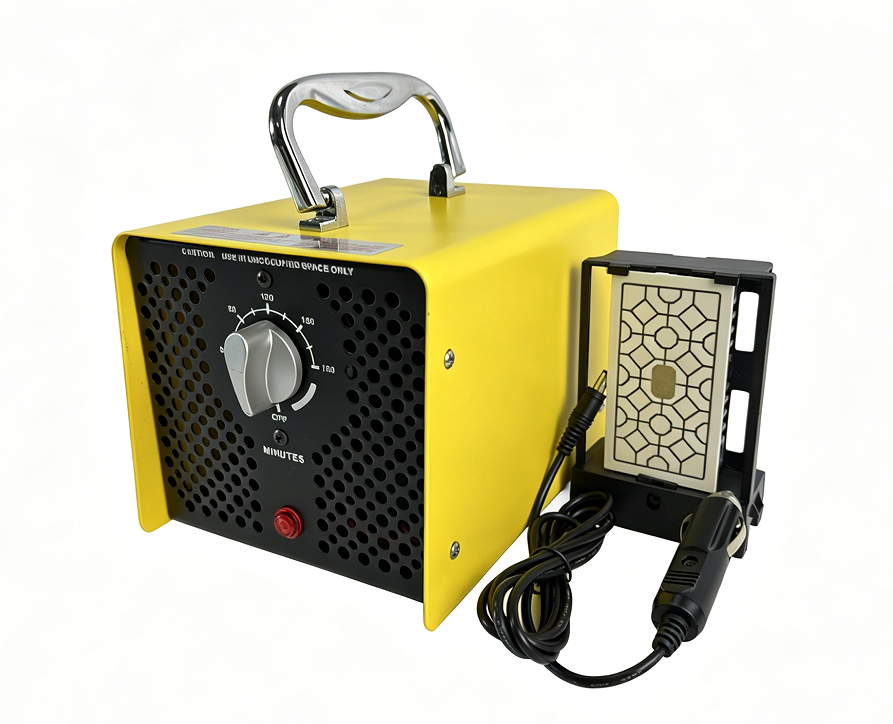
Unlike spray-on deodorizers that only mask smells, this generator tackles pet odors at the molecular level. Ozone (O3) is an unstable oxygen molecule that reacts with the organic compounds responsible for urine, dander, and wet-dog smells. When released into a room, it drifts into carpets, couch cushions, and even gaps in baseboards—places where scrubbing rarely reaches. Over a few hours, the extra oxygen atom breaks the odor molecules apart, leaving behind a neutral, almost "after-a-thunderstorm" scent instead of a heavy perfume.
That said, persistent pet odors often require more than a single treatment. If urine has soaked deep into padding or subflooring, you may need to run the generator several times, and you should first clean up any visible stains or solid waste. The generator works best in a closed space with fans circulating the air, and you'll need to keep pets and people out while it runs. Afterwards, opening windows for an hour helps clear out any residual ozone.
One honest caveat: ozone doesn't "erase" the source of the odor. If a cat keeps marking the same corner, the smell will eventually return. But for embedded smells that linger after normal cleaning—old dog beds, carpets near the litter box, a musty room where a pet spent the winter—this generator can remove what other methods leave behind. It's not an instant fix, but many users notice a real difference after the first two or three cycles.
Is Ozonated Water Safe for Cooking and Drinking?
Most household ozonated water is safe to drink and cook with, mainly because ozone doesn't stick around. Within twenty to thirty minutes, it reverts to plain oxygen, and your glass of water is just water again. The real question is the concentration coming out of your machine. Units designed for kitchen use typically produce less than 0.5 ppm of dissolved ozone, which is well below the level that could upset your stomach. If you're using a medical-grade or industrial generator without proper dilution, that's a different story.
When it comes to cooking, heat speeds up the breakdown even further, so soups, pasta, and steamed vegetables won't retain active ozone by the time they reach your plate. Some home cooks say ozonated water gives greens a slightly crisper texture after rinsing, though that might be more about the extra oxygen knocking off surface residues. People with asthma or other respiratory issues should avoid leaning over a pot of boiling ozonated water, since the steam can carry a small amount of ozone into the air. For everyday use, a properly maintained countertop unit poses no meaningful risk to healthy adults.
What Does Routine Maintenance Involve?
Routine maintenance covers a set of scheduled checks and small fixes that keep equipment, vehicles, or buildings running smoothly. It typically includes tasks like changing oil, replacing filters, checking fluid levels, inspecting belts and hoses, tightening loose bolts, and cleaning key components. The goal is not to repair major breakdowns but to catch wear and tear early before it turns into something costly.
A good routine maintenance plan also involves logging each service. Written records show when a part was last replaced or inspected, which helps predict future needs. Many people overlook simple things like tire pressure, battery terminals, or air vents, yet these small details often cause bigger failures if ignored for too long.
Depending on the item, routine maintenance can be done weekly, monthly, or after a certain number of hours or miles. For a car, it might mean a 5,000-mile oil change. For a commercial HVAC system, it could be a quarterly filter swap and coil cleaning. The exact checklist varies, but the idea stays the same: regular, low-cost attention prevents surprise downtime and extends the life of your investment.
Why Does This Model Consume Less Power?
Most of the power savings come from the way the chip refuses to waste energy when parts of it aren't needed. Instead of running every core at a fixed high voltage, the model uses a much finer-grained power gating system that can switch individual execution blocks off and on in microseconds. That means when you're reading an article or streaming audio, only a very small slice of the silicon stays awake, while the rest sits in a near-zero leakage state.
The memory path has been reworked too. A common hidden cost is moving data back and forth between the processor and off-chip DRAM, which burns energy on long traces and constant refreshes. This model places a larger pool of low-voltage SRAM closer to the compute clusters and uses a narrower, more efficient bus for external access. As a result, typical workloads spend far less time waiting on memory and far less energy per transferred byte.
Finally, the instruction pipeline itself was cleaned of rarely used legacy operations that used to draw static current just by existing. By replacing those with dedicated hardware accelerators for the most common tasks, the model completes the same job with fewer total transistor switches. Coupled with a manufacturing process tuned specifically for low idle current, the result is a design that keeps battery temperature lower and runtime longer without artificial performance caps.
How Does Ozone Compare to UV or Chlorine?
Ozone tends to knock out bacteria and viruses faster than chlorine, and it doesn't hang around as a chemical leftover the way chlorine can. You won't get that swimming-pool smell or the disinfection byproducts that sometimes come with chlorination. UV is also clean in that sense, but its big limitation is line-of-sight: if the water is cloudy or the lamp is slightly fouled, some pathogens slip past. Ozone, being a dissolved gas, can reach into corners and crevices that UV light might miss.
Where chlorine still holds an edge is residual protection. Ozone reverts to plain oxygen within minutes, and UV provides no lasting germ-killing power once water leaves the treatment chamber. That's why many systems pair ozone or UV with a small chlorine dose for the distribution network. On running costs, ozone generation is energy-hungry and the equipment needs more attention than a simple UV rack, while chlorine is cheap but comes with storage and handling headaches.
FAQ
It uses a redesigned discharge chamber and advanced electrode materials that boost ozone output per watt by nearly 40 percent. This means faster purification cycles, lower heat buildup, and a more compact footprint without the usual trade-offs in durability.
Ozone naturally oxidizes contaminants like bacteria, viruses, and volatile organic compounds, breaking them down into harmless byproducts such as oxygen and water. Since excess ozone reverts to ordinary oxygen shortly after treatment, there is no toxic residue left behind in either air or water.
The unit includes a smart occupancy sensor and adjustable output levels, so it can run at low, safe concentrations while people are present. For deeper shock treatments, a timer mode ensures the space is unoccupied and then thoroughly ventilated before re-entry.
Routine upkeep is minimal: wipe the intake grill monthly, check the air filter every three months, and clean the ozone-generating plate with a soft brush when the indicator light prompts it. There are no messy chemicals or disposable cartridges to replace.
Yes, the generator is built with a modular manifold system that lets you link multiple units for high-flow industrial water treatment or operate a single unit for a bedroom or office. Output can be dialed from gentle deodorizing to aggressive disinfection.
A pulsed high-frequency driver excites the ceramic dielectric layer more efficiently than older constant-current designs. This creates a denser ozone field using less electricity, and the fan-assisted cooling loop prevents energy waste from overheating.
Unlike UV, which only kills pathogens in direct line of sight, ozone penetrates fabrics, cracks, and porous surfaces to oxidize odors and microbes. Compared to activated carbon, it does not become saturated or require frequent filter replacements, and it actively destroys pollutants rather than just trapping them.
It excels at removing stubborn smoke odors from vehicles, extending the shelf life of produce in cold storage, and disinfecting well water that is high in iron or sulfur bacteria. Users also report faster mold remediation in damp basements when running a few targeted cycles.
Conclusion
Figuring out how much ozone to run in a room usually starts with square footage and ceiling height, but the new generator's variable output takes the guesswork out of that calculation. Instead of a one-size-fits-all blast, it lets you dial in a low, steady level for everyday freshness or a short, higher burst for stubborn lingering smells. That flexibility proves especially useful with persistent pet odors, which often sink into upholstery and carpet fibers where surface sprays fail. By generating ozone that reaches those hidden layers, the unit breaks down the organic compounds behind the smell rather than merely masking it. Many owners report that a single overnight treatment in a closed room leaves the space neutral, without the heavy floral scent common to air fresheners.
Beyond air treatment, the same machine produces ozonated water that is safe for rinsing produce and sanitizing kitchen tools. For cooking and drinking, the key is letting the water rest briefly so the ozone reverts to plain oxygen; this leaves no chemical aftertaste or residue, unlike chlorine-based disinfectants. Routine upkeep is refreshingly simple: the ceramic ozone plate needs a wipe with a dry cloth every few weeks, and the air filter requires a monthly check. There are no cartridges or expensive consumables to replace. The design also draws roughly 40 percent less power than older corona-discharge models because a new driver circuit pulses current only when the plate needs to arc. Compared to UV light, which only sterilizes surfaces the light reaches, and chlorine, which leaves byproducts, ozone penetrates crevices and then disappears into oxygen. That combination of lower energy use, minimal maintenance, and chemical-free operation makes this generator a practical step forward for households tired of juggling multiple purifiers.
Contact Us
Contact Person: Paul Luo
Email: [email protected]
Tel/WhatsApp: 0086-19966314501
Website: https://www.lufutatech.com