

ODM Industrial Sectional Door: What You Need to Know Before Ordering
2026-09-28
Most buyers treat an ODM industrial sectional door like a standard catalog item—until the first service call proves otherwise. From panel profile to spring cycles, the choices you make now dictate maintenance costs for a decade. NORTON has seen too many order forms with missing load ratings and vague track specs, so here’s a no-nonsense rundown of what actually matters before you commit.
Who Actually Builds Your Door When You Order ODM?
Who Actually Builds Your Door When You Order ODM?The short answer? It's rarely the company whose logo ends up on the packaging. When you place an ODM door order, the actual production often lands in the hands of one or more third-party factories that you may never see in any contract. These facilities are selected by the ODM provider based on capacity, cost, and location, and the decision can shift from one order to the next without your knowledge. You might sign a deal with a trading company in Hangzhou, but your doors could be welded in Hebei, painted in Shandong, and assembled in a small workshop that also makes window frames for another client.
The deeper you dig into the supply chain, the blurrier the line between designer and builder becomes. An ODM company typically owns the technical drawings and quality specs, but the physical labor—cutting steel, applying powder coat, installing hinges—is done by subcontractors who work off those files. In many cases, the main contractor will outsource component production to smaller shops: one for door panels, another for frames, a third for hardware. Final assembly might happen at the main factory, or it might be done on-site by the installer you hired separately. This fragmentation means the door that arrives at your project could have passed through four or five pairs of hands, each adding a layer of variability that no spec sheet can fully capture.
If you truly need to know who builds your doors, ask for a factory audit before the first purchase order is cut. Request the names and addresses of all production sites, not just the sales office, and verify them through video walkthroughs or independent inspection. Some buyers go further and require that the ODM provider disclose any planned subcontracting, with written approval needed before work shifts to another facility. Without that level of control, you're essentially buying a promise—and the person who actually welds your door frame might be someone you will never meet.
The Spec Sheet Trap: What Most Buyers Overlook
Most buyers open a spec sheet and immediately scan for the largest numbers—megapixels, watts, gigabytes—without asking how those figures hold up under real use. A camera with a huge sensor can still produce soft images if the lens is mediocre, and a speaker rated at 100 watts might distort badly at half that volume. The sheet gives you peak values, not the curve.
Another blind spot is compatibility and longevity. A laptop can list a fast processor and plenty of RAM, yet throttle within minutes because of poor cooling. Ports, driver support, and firmware updates rarely make the headline specs, but they decide whether a device stays useful or becomes a paperweight. Buyers who skip the fine print often pay twice.
Then there's the matter of how the product feels in daily life—keyboard travel, fan noise, button placement, screen coating. None of these appear on a typical spec sheet, and yet they shape your experience far more than a marginal bump in clock speed. The trap isn't the data; it's treating the data as the whole story.
How Custom Is 'Custom'? Asking the Right Questions
The word “custom” gets tossed around until it stops meaning much. One vendor’s custom is a color swap on a template; another’s is a build that starts with a blank board and a list of constraints. If you don’t pin down what you actually need, you can pay bespoke prices for something that was mostly pre-cut.
Ask what changes, what stays fixed, and who makes the final call on trade-offs. A genuinely tailored result depends less on the label and more on the boundaries you set for materials, dimensions, code, integration points, or lead time. Get the other side to walk through a recent job that they consider custom, and listen for where their process got messy. That mess is where the real tailoring happens.
Finally, separate “custom” from “customizable.” One means the thing is built around your constraints from the start; the other often means you can adjust a few preset options later. If the answer to “what can’t be changed?” comes back vague, the custom part may be thinner than the pitch suggests.
Lead Times and Tooling: Hidden Costs You Didn't Budget For
Most buyers account for the obvious line items—materials, labor, and freight—but lead times and tooling have a way of inflating the final invoice without anyone noticing until it’s too late. A mold that takes ten weeks instead of six doesn’t just delay your launch; it forces you to either pay overtime rates at the factory or miss a retail window entirely. Those extra weeks quietly eat into margins before a single unit ships.
Tooling itself is rarely a one-time purchase. Modifications, maintenance, and replacement cavities show up as separate charges that weren’t in the original quote. If your design changes after the first sample run, expect re-cutting costs and another round of lead time that no one planned for. Smaller production runs spread these tooling costs over fewer pieces, making the per-unit burden far heavier than the spreadsheet suggested.
Then there’s the hidden cost of holding inventory while waiting on delayed components. Warehousing fees, insurance, and tied-up cash flow accumulate during those idle weeks. Some suppliers will offer to split the difference with partial shipments, but that comes with extra logistics coordination and often a higher freight bill. Budgeting a realistic cushion for lead time variability and tooling revisions is less about pessimism and more about not being blindsided.
Testing, Certification, and What Your Facility Really Needs
Facility managers often get caught up chasing every certification that crosses their desk, but the real question isn't how many badges you can collect—it's whether your testing program actually reflects the risks your operation faces day to day. A shiny certificate on the wall means little if your staff haven't been trained to interpret the data behind it. Instead of ticking boxes for an auditor, start by mapping your highest-consequence failure points: equipment that runs hot, processes that involve hazardous materials, or spaces where downtime cascades into production losses. Those are the areas where rigorous, frequent testing pays for itself, not the paperwork that comes after.
The gap between regulatory minimums and operational reality is where most facilities get blindsided. A standard air-quality check might satisfy a local code, but if you're running a cleanroom adjacent to a welding bay, that generic pass doesn't tell you much. Smart facilities treat certification as a baseline, then layer on targeted testing that matches their specific wear patterns and failure histories. For instance, a food processing plant might find that monthly swab tests on conveyor belts catch contamination weeks before an annual audit would, while a data center learns that thermal imaging of busbars predicts failures far better than routine voltage checks. The goal isn't more tests—it's the right tests, at the right interval, for the assets that actually keep you awake at night.
Finally, don't confuse documentation with capability. A certified technician who's never touched your specific legacy equipment won't spot the early signs of bearing wear that a seasoned in-house operator notices by sound alone. The strongest facilities blend external certifications with internal knowledge: they use third-party audits to validate their processes, but they also build a simple, honest log of what failed between inspections and why. That log—not the certificate—becomes the real driver for adjusting test frequencies, retraining staff, or replacing aging infrastructure. After all, your facility doesn't need another framed document; it needs a testing strategy that would still make sense if no auditor ever showed up.
After-Sales Support: The Part Nobody Puts in the Quote
Most quotes stop at the equipment price, maybe an installation fee, and a line for training days. After-sales support rarely appears as a concrete clause. Buyers assume it exists, sellers assume it’s understood, and the silence gets filled only after delivery, when something breaks and nobody quite owns the “what now.” That quiet assumption is the first reason support gets left out of the quote.
The real cost isn’t parts or labor—it’s response time. A critical machine down can burn more money per hour than the entire discount a buyer fought for during negotiation. Yet purchasing decisions still lean on upfront numbers because after-sales support refuses to be quantified before signing. It doesn’t fit a spec table or a red sticker. So it waits until the day an alarm goes off and no one is ready.
Smart buyers ask specific questions before the quote is final: What’s your standard response time? Are spare parts kept locally or shipped from overseas? Is phone support free after the first year? Do software updates come with the contract? These questions reveal more about a vendor than any brochure. Putting support into the quote may not always lower the price, but it keeps you from standing alone at 3 a.m. staring at a blinking fault light.
FAQ
ODM means the manufacturer designs, engineers, and produces the door based on your specifications, then applies your brand or logo. You provide the performance requirements and design direction, while the supplier handles the technical documentation, prototyping, and production. It works well if you want to expand your product range without investing in your own factory or R&D team.
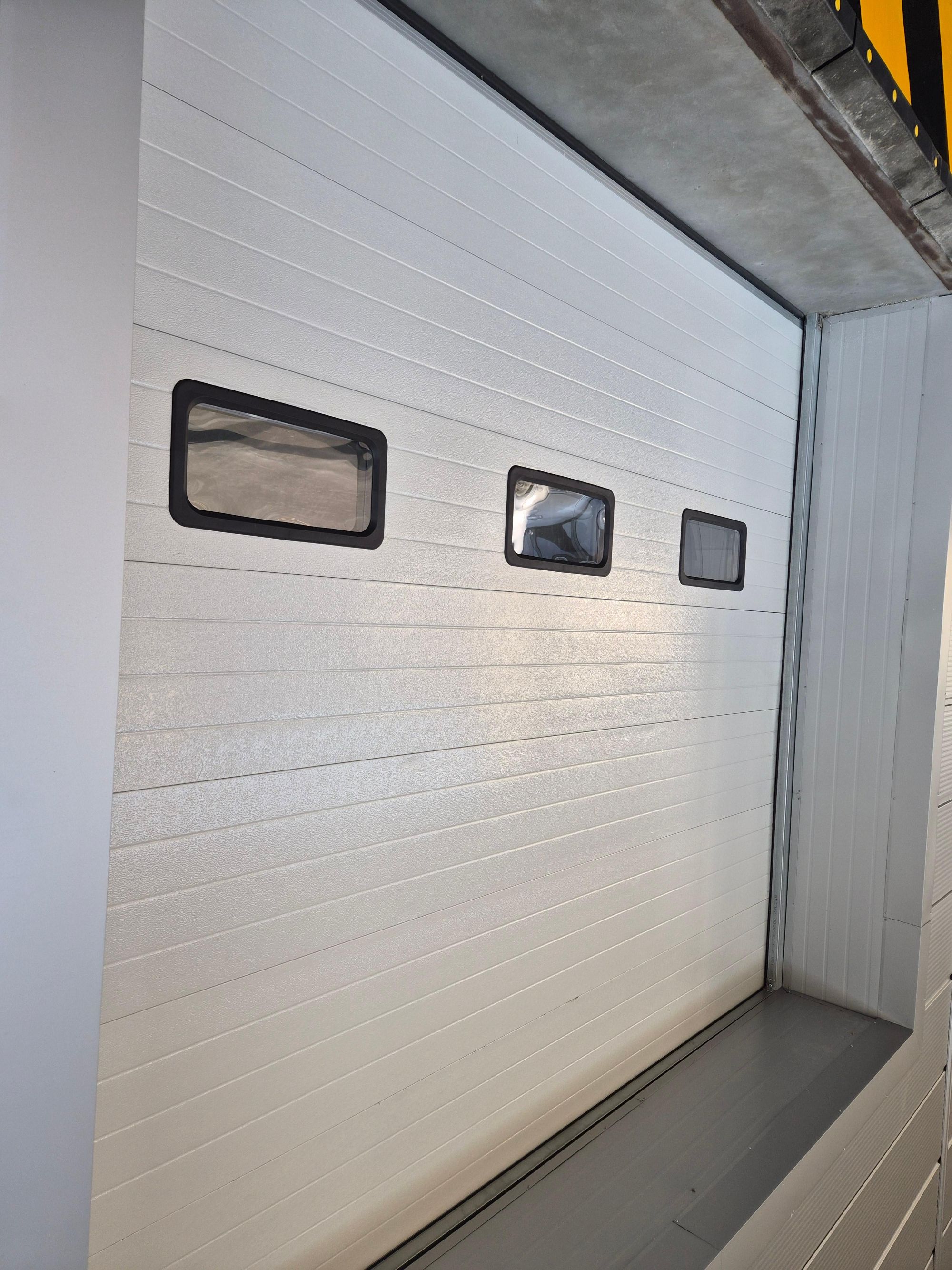
Start with the operating environment. Galvanized steel panels are a solid default for warehouses and distribution centers. Stainless steel or coated panels hold up better in food processing, chemical plants, or coastal areas with high humidity and salt exposure. Aluminum panels work for lighter openings where weight is a concern. Also consider insulation: polyurethane foam gives better thermal performance than polystyrene, which matters if the door separates temperature-controlled zones.
You need the exact opening width, height, side room, headroom, and floor level. Record any obstacles on either side or above the opening, such as pipes, beams, or cable trays. Even small deviations can affect track mounting and panel travel. Have someone use a laser measuring tool and double-check all dimensions at three points: left, center, and right. A difference of more than 5 mm usually needs correction before production starts.
Yes, most ODM suppliers allow customization of panel color, surface texture, window placement, handle style, hinge finish, track layout, and motor brand. However, each change affects production time and cost. Standard options are faster and cheaper because the supplier already has molds and stock. Non-standard colors or special track configurations may require new tooling or additional engineering, so confirm which choices are true custom work before you commit.
At a minimum, require torsion spring containment to prevent parts from flying if a spring breaks, cable break protection, and a bottom safety edge or photoelectric sensors that stop and reverse the door when something is in the way. A manual chain hoist or crank is essential for power outages. If the door will cycle frequently, add motor thermal overload protection and an automatic reverse function. These features are not optional extras; they are baseline safety for industrial use.
A standard configuration usually takes 15 to 25 days to produce, plus shipping time by sea or land. If you choose custom colors, non-standard sizes, special insulation, or a different track system, production can extend to 35 to 45 days or more. Around major holidays or peak construction seasons, add an extra one to two weeks of buffer. Confirm the exact timeline in writing, including packaging and loading dates.
Make sure the floor is level and the concrete has reached full strength. Check that a dedicated power supply is available near the motor location, with the correct voltage and frequency. The opening should have adequate structural support on both sides, typically steel columns or reinforced masonry. Clear the work area of debris and ensure the installation crew has safe access, including enough space for ladders, lifts, or scaffolding. If the door is large, arrange for a forklift or crane to unload panels and tracks.
Ask for samples of the panel construction, not just color swatches. Request test reports for wind load rating, thermal transmittance, and cycle durability. Visit an existing installation or have a video call with a technician showing the door in operation. Review the warranty terms separately for springs, panels, and motor, because coverage periods often differ. Finally, check whether the supplier can provide detailed installation drawings, spare parts lists, and after-sales support in your region.
Conclusion
Before placing an ODM industrial sectional door order, you need to dig past the polished catalog. The first question isn't about panel thickness—it's who actually welds, assembles, and ships the door under your name. Many buyers assume the factory they're negotiating with is the builder, but subcontracting is common. Ask for the production floor location, recent line photos, and a sample sticker with the real manufacturer code. Then pull apart the spec sheet. A door that looks identical on paper—same gauge steel, same spring rating—may use thinner end stiles, weaker hinges, or foam with lower density once you inspect the cutaway. Get a full BOM (bill of materials) rather than a marketing PDF.
'Custom' rarely means anything without a list of what can actually change. Does the factory alter panel height, track radius, or wind-load reinforcement, or are you just picking from preset modules with color changes? Lock down engineering drawings before deposit. Also budget for tooling: new roll-forming profiles or punch dies often carry non-recurring charges that don't appear in the initial quote. Lead times stretch when a fabricator waits on steel coils or shares a line with other clients. Certification matters too—CE marks, UL listings, or local fire ratings need to match your facility's inspection environment, not just the spec sheet. Finally, ask for a written after-sales response: spare parts inventory, troubleshooting response hours, and warranty terms for springs, operators, and panels. Otherwise, you'll own a door that costs more to maintain than it did to buy.
Contact Us
Contact Person: Cyril He
Email: [email protected]
Tel/WhatsApp: 8613969697307
Website: https://cqyqgd.en.alibaba.com/