

OEM Executive Office Chair: How to Choose the Right Model for Your Workspace
2026-10-19
Your executive chair is more than a seat—it's where focus, posture, and long-term comfort either hold up or break down. With OEM options flooding the market, choosing the right model can feel like guesswork. At OFCJNS, we've seen too many professionals settle for chairs that look impressive but fail by month three. This guide cuts through the catalog gloss to show you what actually deserves your attention before you invest.
What OEM Actually Changes About Your Chair Order
Plenty of buyers assume an OEM order means the factory will redraw the chair from scratch. In practice, the changes are narrower and more predictable. You are usually picking from a fixed menu: fabric grade and color, logo placement or embroidery, maybe the finish on the aluminum base, and occasionally the armrest style if the mold already supports it.
What rarely changes is the underlying frame, the foam density, the mechanism, or the overall geometry. Those parts are tied to existing tooling and safety certifications. A factory may swap the mesh from black to grey or add a printed logo under the headrest, but they won't alter the lumbar curve or lengthen the seat pan unless you are committing to new tooling and a much larger order.
So the real question to ask a supplier is not 'can you customize it?' but 'which options are already open on this platform?' That tells you fast whether the OEM price is worth it or whether you are just paying extra for a different color on a chair that stays exactly the same underneath.
Ergonomics That Hold Up After Hour Four
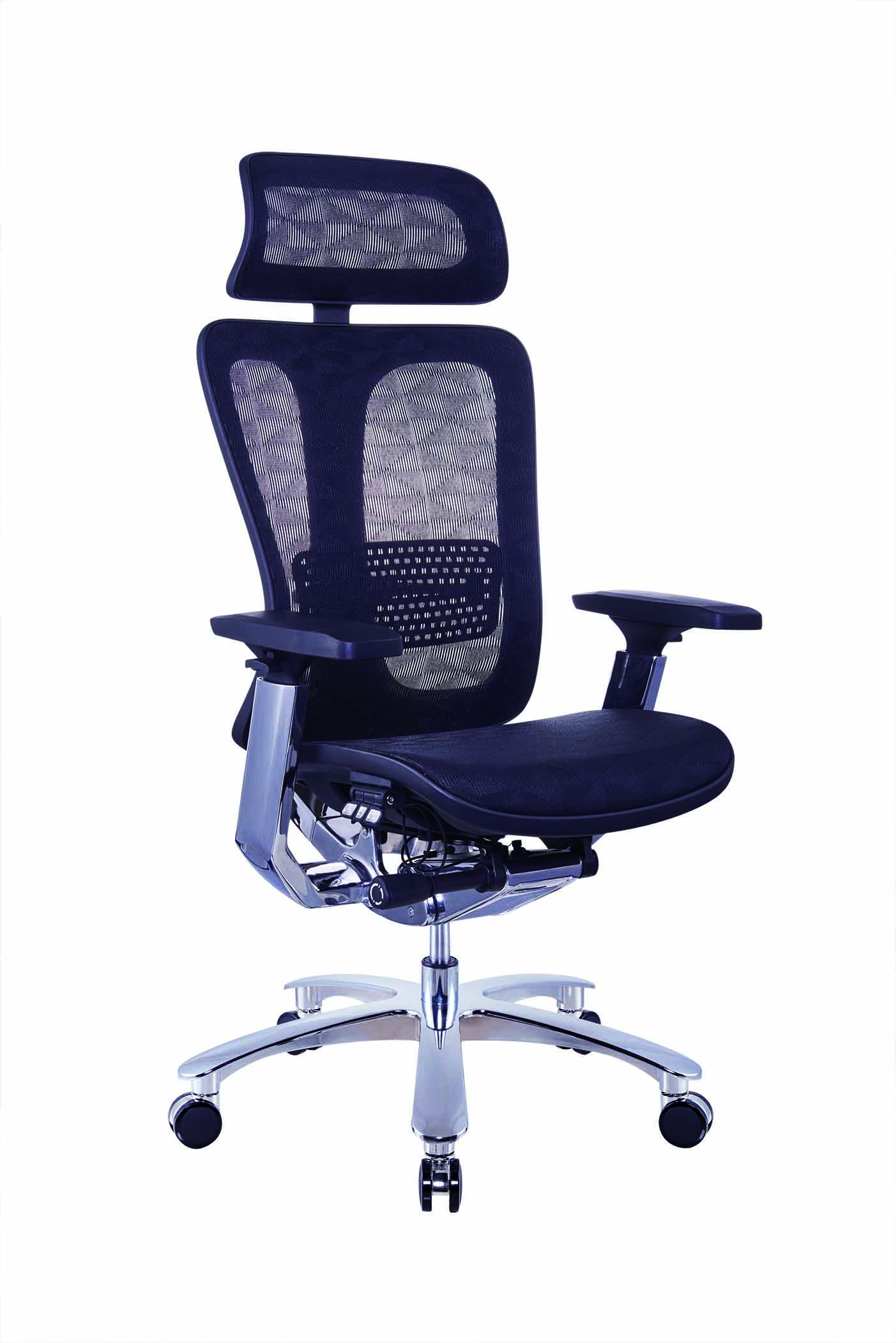
Most chairs feel fine at minute twenty. By hour four, the story changes. The foam bottoms out, the lumbar pad drifts out of place, and you start shifting weight every few minutes without realizing why. Proper ergonomic design doesn't just cushion you at first contact—it manages pressure over extended sessions so that your lower back, hips, and shoulders stay aligned long after the initial comfort fades.
What separates furniture that lasts through hour four from the rest often comes down to how it responds to movement. A seat pan with graduated firmness stops your sit bones from sinking too deep, while a backrest that flexes slightly as you recline keeps support against your spine instead of pushing back at one static point. Armrests with enough vertical and lateral range let you drop your shoulders without forcing your elbows into an awkward hover. These details don't advertise themselves on a showroom floor; they show up only after you've stopped noticing the chair entirely.
Then there are the materials and frame joints that quietly resist wear. Dense, high-resilience foam recovers its shape instead of flattening under body heat. Upholstery with a slight texture breathes better than slick synthetic leather when you're hours into a task. And a base that stays stable during small posture shifts prevents that slow slide into a slouch. The result isn't a magical "no fatigue" claim—it's simply a chair that still behaves like it did at hour one, which is rarer than it should be.
Upholstery and Frame Materials That Earn Their Price
The real cost story starts inside the frame. Cheap sofas hide softwoods, staples, and glue where you can't see them. Pieces built to earn their price use kiln-dried hardwood like maple or birch, reinforced with corner blocks and double dowels. That kind of joinery resists twisting and creaking years after delivery, which is exactly when the bargain frame starts to wobble.
Suspension and cushion fill are the next honest tell. Eight-way hand-tied coils still beat sinuous springs for even support, but only when paired with high-resilience foam or a down-and-feather wrap. Skip the low-density polyurethane that flattens in a season; a dense core with a soft crown keeps its shape under daily use without turning into a rock.
Upholstery fabric and leather aren't just about looks. Full-grain or top-grain leather develops patina instead of peeling, and woven fabrics with a rub count above 50,000 shrug off abrasion from kids and pets. Natural fiber blends breathe better than bonded or corrected materials. When the cover still looks intentional after five years, the higher upfront price stops feeling like a splurge and starts acting like arithmetic.
Adjustability Features You'll Really Use
Instead of stuffing the chair with dials you'll never touch, we focused on the few adjustments that matter daily. Seat depth slides forward just enough to support taller legs without leaving shorter users perched on the edge. Armrests move in four directions, but the controls are so obvious you can tweak them mid-call without looking down.
Lumbar support isn't a vague knob that spins endlessly—it's a two-paddle system that raises or lowers the curve to match your spine's actual bend. The headrest tilts and locks with one hand, which sounds minor until you've spent an hour fighting a stiff mechanism. Even the backrest tension adjusts in small, meaningful steps rather than a vague twist.
These aren't features you'll use once during setup and forget. They're designed to be re-engaged when you switch from typing to reading, or when someone else borrows your chair. That kind of quiet flexibility is what keeps your body from complaining after hour three.
Sizing the Chair to Your Workspace Without Guesswork
Grab a tape measure and note the distance from the floor to the underside of your desk. Set the chair height so your thighs stay roughly parallel to the floor with your feet flat, and your elbows fall naturally at desk level. That usually means the top of the seat cushion sits about two to four centimetres below the desk’s lower edge—ignore the size labels on the box and work from that measured gap instead.
Before you settle on a model, check the space between the desk legs or side panels. A chair with armrests that stick out wider than that opening will force you to sit twisted or perch on the front edge just to type. Roll the chair in from the side and make sure the armrests clear the underside without scraping, and leave enough room behind you so the backrest doesn’t slam into a shelf or wall when you lean back.
Seat depth matters more than most people expect. Sit on a flat surface and measure from the back of your bent knee to the base of your spine, then look for a seat pan that’s two or three centimetres shorter. That lets your knees bend without pressure while the cushion still supports your full thigh. Push your hips all the way back and check that the lumbar curve of the backrest lands in the small of your back, not mid-spine or just above your belt line.
Long-Term Costs: What Breaks First on Cheaper Models
When you buy the budget version of a tool or appliance, the upfront savings rarely tell the whole story. The first components to fail tend to be the ones that see constant movement or heat: plastic gears, thin drive belts, compact motors with undersized windings. On a cheaper washing machine, for example, the drain pump or door seal usually goes long before the drum bearings do. These aren't random failures; they reflect deliberate cost-cutting on parts that don't affect the showroom spec sheet.
Electrical connections are another weak point. Lower-priced models often use crimped terminals instead of soldered joints, thinner gauge wiring, and control boards without conformal coating. Moisture and vibration get into those joints over time, leading to intermittent faults that are hard to diagnose. You might spend more on a single service call than the appliance cost new. That's the hidden math: replacing a $40 control board on a $300 dryer makes sense; doing it twice on a $180 dryer doesn't.
Finally, pay attention to what isn't covered by the warranty. Many cheaper models come with a one-year limited warranty, but the longest-lived parts are often excluded after 90 days. If the manufacturer expects a part to fail, the warranty terms usually reveal it. Look for short coverage periods on seals, switches, and plastic components. Those are the parts that drive long-term ownership costs, even when the main motor still runs fine.
FAQ
Grab a tape measure and check the height from the floor to the top of the desk or keyboard tray. Then measure the clearance under the desk and the width of the doorway or any tight corner the chair has to pass through. Those numbers alone eliminate a surprising number of models, especially high-back chairs with tall gas lifts.
Look for a backrest that lets you adjust the lumbar pad’s depth and height, not just a fixed bulge. If the OEM doesn’t show those two adjustments, ask for a sample. A fixed lumbar curve hits around 15% of people well; everyone else ends up pushing a cushion behind their back.
Bonded leather is mostly ground-up scraps pressed with adhesive and a plastic coating—it peels quickly. PU leather is synthetic, easier to clean, and lasts longer at a lower price, but it can feel warm. Genuine leather breathes better and ages visibly, which some people like, but it costs more and needs conditioning. For a shared office, PU is usually the practical middle ground.
Not really. A very thick but soft cushion collapses after a few months and puts pressure on your thighs. Instead, check the foam density—anything around 45 kg/m³ or higher holds shape better—and look for a waterfall edge at the front. That edge reduces pressure behind the knees during long calls.
At minimum, make sure the seat height, seat depth, armrest height, and tilt tension can be changed without tools. If shorter and taller people share the chair, pay extra attention to the seat depth range. A chair that fits a 5'2" person may not fit a 6'3" person unless the seat pan slides far enough forward.
Many standard models list 250 lb (about 113 kg), but that figure is often optimistic. If people above that limit will use the chair, choose a model rated for 300–350 lb and check the gas lift class—Class 4 is fine for most office use, but Class 3 can sag sooner. Also look at the base: aluminum lasts longer than nylon under repeated load.
If anyone leans back for calls, reads documents, or takes short breaks at the desk, a high back with an adjustable headrest pays off. But for a compact desk or a small room, a high back makes the space feel cramped and bumps the wall. A mid-back without a headrest is lighter and cheaper, but it won’t support the neck during reclined work.
Ask about minimum order quantity, lead time for a custom logo, the warranty on the gas lift and mechanism, and whether they can send a sample with the exact fabric and foam specs you’ll receive in bulk. Also ask for the BIFMA test report if they have one—that gives you a clearer picture than a marketing photo.
Conclusion
Ordering an OEM executive chair means you control the spec sheet before it reaches production—everything from foam density and tilt tension to the grade of mesh on the backrest. That level of input pays off most in hour five, when a chair either starts fighting your spine or disappears under you. Look for a lumbar curve that tracks your lower back without digging in, and a seat pan that doesn't pinch behind the knees. Cheap foam collapses after a few months; high-resilience molded foam and a frame with glass-fiber reinforcement hold their shape long after the warranty card is forgotten.
Don't get seduced by adjustment knobs you'll never touch. The ones that matter are seat depth, armrest height and width, and a synchro-tilt that keeps your feet planted while you recline. Measure the actual room around your desk, not just the chair's listed width—armrests need clearance to slide under the worksurface, and the backrest shouldn't crowd a credenza behind you. On long-term costs, the first failures on budget models are nearly always the gas lift, caster stems, and armrest pads. Spending more on a replaceable gas cylinder and metal arm cores saves you from buying a second chair in eighteen months.
Contact Us
Contact Person: Diff Wang
Email: [email protected]
Tel/WhatsApp: +8613650281199
Website: https://www.ofcmeshchair.com/