

OEM T10 LED Parking Light Bulbs Worth Upgrading for a Cleaner Brighter Look
2026-11-19
Most drivers never think about parking lights until one looks dim, yellowed, or uneven next to the other. If you are still running stock T10 bulbs, you are leaving a simple visual upgrade on the table. Swapping to LUXFIGHTER T10 LED parking light bulbs gives the front end a cleaner, brighter, and more modern signal without blinding oncoming traffic or triggering canbus errors. Here is what actually changes after the swap, and why it is worth doing before your next drive.
Why the stock T10 glow gets lost at dusk
The stock T10 filament was never built to fight twilight. Its output sits in a narrow warm band, and once the sky shifts to a deep blue-gray, that amber spill reads as noise rather than a signal. The bulb is still glowing, but the surrounding dusk is bright enough to swamp the small filament's contrast.
There is also a shift in how the eye processes light at that hour. In daylight, photopic vision favors the yellow-green range; as darkness approaches, mesopic vision takes over and the warm end of the spectrum drops in perceived brightness. The stock T10, already limited in luminance, falls into the exact part of the spectrum that loses priority during dusk.
Add the lack of a focused reflector or sharp cutoff in many stock housings, and the glow scatters instead of staying visible. At noon that scatter is invisible; at dusk it becomes the reason the bulb seems to turn off. The power is there, but the environment no longer gives it a dark enough stage.
A cleaner beam starts with the diode layout
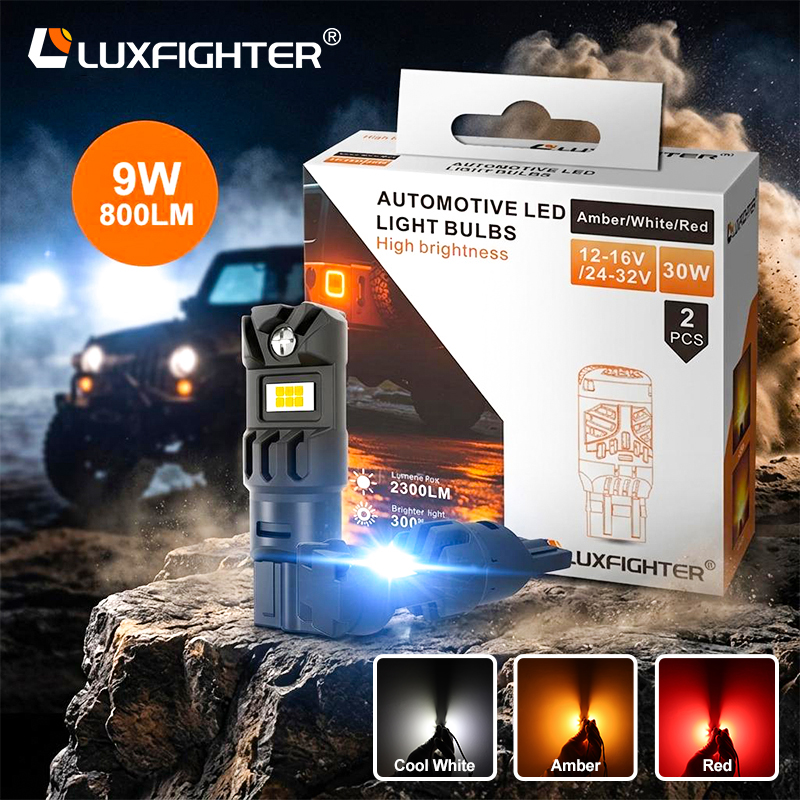
Emitter spacing is rarely the first thing people point to when a beam looks ragged, but it is often where the problem begins. When diodes are packed for higher output without rethinking the slow-axis fill, the resulting beam picks up hot spots and uneven divergence that downstream optics can only partially clean. A layout that respects the actual numerical aperture of each emitter—rather than just the available mechanical real estate—produces a beam that starts with fewer artifacts.
The physical arrangement also influences thermal behavior across the stack. If coolant channels or mounting points create an uneven temperature gradient, individual emitters drift by slightly different amounts, and the collimated beam develops skew or side lobes. Staggered rows and small adjustments to baseplate geometry can reduce this by keeping the thermal path shorter and more symmetric, which matters more than adding another lens element to correct the output.
What makes a diode layout genuinely effective is not how many bars fit in the package but how predictably they behave once powered. Leaving room for precise fast-axis collimation and setting the emitter pitch to match the slow-axis collimator keeps the beam from blooming at the edges. It is a quieter approach to brightness: the beam stays cleaner because the source was arranged to avoid the common failure modes instead of fixing them after the fact.
Brighter doesn’t have to mean blue or harsh
A brighter room often gets mistaken for a colder one, as if the only way to chase out shadows is to flood the space with sterile, blue-tinted light. That assumption misses what actually makes a space feel vivid. Brighter can arrive through warmer tones, layered sources, and materials that catch the glow without turning your home into a laboratory. The goal is not intensity for its own sake, but clarity that keeps skin tones, wood grain, and fabric textures looking natural.
Think of morning light through a linen curtain or late afternoon sun across a clay wall. Neither of these moments feels harsh, yet both lift the room's energy. You can recreate that effect with bulbs in the 2700K to 3000K range, paired with dimmers and a mix of overhead, task, and accent lighting. The result is a space that feels awake and easy to be in, not one that makes you squint when you walk through the door.
Small shifts also help: swapping a single glaring ceiling fixture for two softer lamps, choosing a shade that diffuses light instead of directing it, or adding a warm reflector behind a shelf. These choices let brightness behave like atmosphere rather than a spotlight. The room opens up, details come forward, and nothing about the light asks you to brace for it.
The five-minute swap that sharpens the front end
Five minutes is enough to change how a page loads, but only if you resist the urge to fix everything at once. Pick the heaviest render-blocking request in the first view. It is rarely the framework itself; more often it belongs to a chat widget, a chunk of unused CSS, or a web font that could be swapped for system type on the first load. Move that single item off the critical path and measure the difference before touching anything else.
The swap itself is usually mechanical: add a deferred script, split an import behind a media query, or replace an icon font with a handful of inline SVGs. The value comes from keeping the change deliberately small. Large performance passes stall because they touch too many files and require too much review. A five-minute change clears the same bottleneck but stays easy to approve, easy to revert, and easy to repeat next week.
Teams that do this regularly stop treating speed as a one-time milestone and start treating it as routine upkeep. Each small swap leaves the front end slightly leaner, and because the change is limited, it rarely introduces regressions. Over a month the effect compounds, and the page no longer feels as if it is dragging a stack of dependencies behind it.
Avoiding flicker and hyper-flash without extra wiring
Many LED swaps turn into a guessing game the moment the turn signal starts blinking at double speed or the daytime running light flickers on camera. The usual fix involves splicing in resistors or tucking extra load boxes behind the bumper, but that adds clutter and heat. The cleaner route is to choose bulbs or housings that already match the vehicle's circuit expectations, so the body control module sees a stable draw and never thinks a bulb is out.
Hyper-flash is essentially the car's way of warning you about a perceived dead bulb. Instead of tricking the system with add-on parts, look for units with integrated drivers that keep current draw within the original range. That keeps the flasher relay or BCM quiet, and the factory wiring stays completely untouched behind the panel. No vampire taps, no extra terminals, no mess.
Flicker usually comes from pulse-width modulated power or low-voltage detection, especially on running lights and parking lamps. A properly designed internal circuit smooths that signal on its own, so the output remains steady without needing capacitors wired across the socket. The result is a stable beam, a factory-style blink rate, and an install that still looks bone stock under the hood.
Matching the parking light color to the rest of the car
Getting the parking light hue right comes down to looking at the whole car rather than treating the lamps as an isolated detail. If the headlights lean cool white and the fog lights glow warm, a mismatched parking light can make the front end feel slightly off even when each bulb works fine on its own. The practical move is to check how the existing bulbs behave at dusk, then pick a replacement that sits close to that same temperature instead of chasing the brightest option on the shelf.
Older halogen setups tend to have a softer, yellowish cast, while many modern LED swaps push toward a crisp blue-white. Neither is wrong, but mixing the two without a plan often creates a patchwork look that draws attention for the wrong reason. If you have already converted the main beams to LED, keeping the parking lights in a similar range helps the front profile read as one piece. On the other hand, a faintly warm parking light against cool daytime running lights can actually look intentional if the color gap is small and consistent on both sides.
Before buying, it helps to park the car against a plain wall and compare the current parking light output with the headlights and turn signals from a few feet back. Small differences in color temperature become easier to judge that way, especially as the light fades. Where local rules allow, a slight variance can add character, but the goal is still a calm, balanced front end rather than a cluster of competing tones.
FAQ
The beam becomes noticeably cleaner and more defined, with a crisper presence in the housing. The color moves away from the dull yellow of a standard halogen to a cooler white that makes the front end look more modern without being harsh.
The difference is obvious at night, especially when the headlights are off and only the parking lights are on. A decent LED T10 will throw a sharper white light instead of a faint amber glow, but it still stays subtle enough not to look like a high beam.
Something in the 5000K to 6000K range usually hits the sweet spot. It reads as pure white next to most modern headlights, while anything above that starts drifting into blue territory and can look cheaper.
For many vehicles, yes. The base matches the original 194 or T10 socket, so installation is just a matter of pulling the old bulb and pushing in the new one. However, because LEDs are polarity-sensitive, you may need to remove and rotate the bulb 180 degrees if it does not light on the first try.
Quality sets often include built-in resistors or canbus-friendly circuitry, which keeps most vehicles happy. Some European models with sensitive bulb monitoring can still detect the lower draw, so an external resistor may be needed on those specific cars.
Heat management is the deciding factor. Units with a compact metal body or a small heatsink tend to last far longer than all-plastic designs, which can discolor and fail early. Parking lights do not run as hot as headlights, so a well-made set should last several years in normal use.
If the vehicle uses the same T10 base, it usually works well in the license plate area and even some interior map lights. Just keep in mind that the brighter output can reveal more dust or condensation around the lens, so cleaning the housing before swapping bulbs makes a bigger visual difference than most people expect.
Conclusion
The factory T10 bulbs usually look fine in a garage but lose their presence once the sun drops, leaving the front end softer than it should be. Swapping to OEM T10 LED bulbs changes that because the diode placement works with the housing instead of fighting it, so the glow spreads more evenly across the lens rather than collecting in one hot spot. The output feels crisp without tipping into that cold, blue aftermarket look; a neutral white around 6000K tends to blend better with factory LED daytime running lights and keeps the car looking original, just more polished.
What makes the upgrade worthwhile is how little effort it takes. Most cars only need a few minutes per side, and the bulbs slide into the same socket without cutting or splicing. Good sets handle canbus quirks internally, so there is no pulsing on startup or hyper-flash when you lock and unlock the car. Since the parking light sits right next to the headlight, matching its color to the rest of the front lighting removes the mismatched yellow halo that often cheapens the overall look. It is a small detail, but at dusk and in parking garages the sharper, cleaner front end is immediately noticeable.
Contact Us
Contact Person: Gavin Chen
Email: [email protected]
Tel/WhatsApp: (+86)756-6831079
Website: https://www.luxfighter.com/