

Stainless Steel Hex Socket Cap Screw Supplier for Reliable Industrial Fastening Solutions
2026-10-06
In the world of industrial fastening, not all stainless steel hex socket cap screws are created equal. The difference lies in the supplier’s commitment to metallurgy, thread precision, and consistent hardening. For teams that refuse to gamble on safety or uptime, the choice of supplier is anything but trivial. Wanluo understands this pressure and has built its reputation on delivering reliable fastening solutions that perform in harsh environments. This blog dives into why this particular screw type matters and how Wanluo’s supply chain and quality control set it apart.
Why Stainless Steel Hex Socket Cap Screws Excel in Harsh Industrial Environments
In chemical processing plants and offshore platforms, fasteners face constant attacks from salt spray, acidic vapors, and extreme temperature swings. Stainless steel hex socket cap screws shrug off these insults because their alloy content—typically 18% chromium and 8% nickel—forms a self-healing passive oxide layer that blocks pitting and crevice corrosion. Unlike zinc-plated carbon steel, which can lose its protective coat after a single scratch, these screws maintain their integrity even when the surface is nicked during installation or maintenance.
The socket head design itself contributes to performance in tough settings. A deep hexagonal recess allows for high torque transfer without camming out, which means workers can secure joints tightly using hex keys or bits even when access is limited or components are coated in grease. This is a practical advantage in cramped machinery housings or food processing lines where frequent washdowns leave everything slick. Moreover, the low-profile head reduces the risk of snagging on moving parts, which helps prevent premature loosening under vibration.
Stainless steel grades like 316 or 17-4 PH bring extra capabilities. For instance, 316 hex socket cap screws contain molybdenum, which boosts resistance to chlorides and sulfuric acid compounds found in pulp mills and wastewater treatment. In high-temperature applications, certain stainless alloys retain tensile strength up to 800°F, making them suitable for exhaust stacks or heat exchangers. Pair that with fine-thread options that offer better grip in thin-walled materials, and it's clear why engineers specify these fasteners when failure is not an option.
Key Material Grades and Coatings for Long-Lasting Fastening Performance
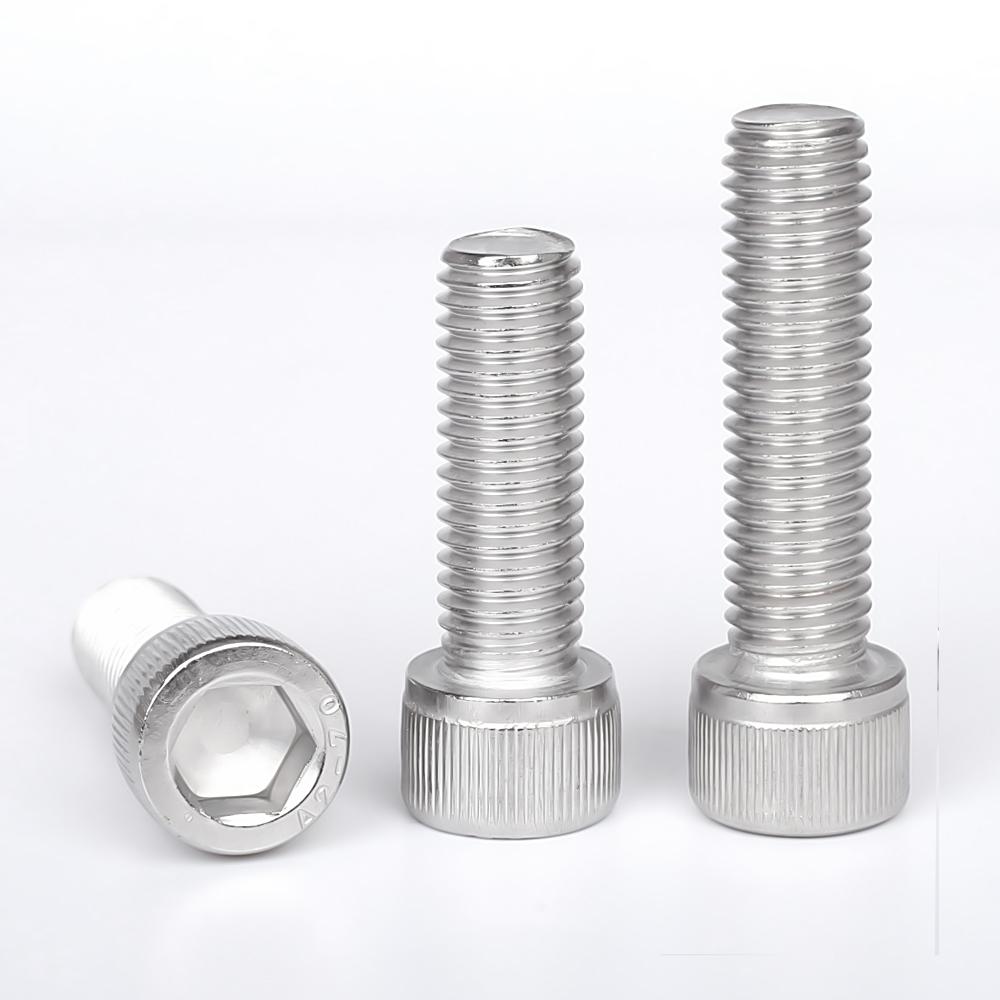
Fastener life often comes down to two choices made long before installation: the base alloy and the surface treatment. Austenitic stainless grades like 304 and 316 remain the default for corrosive or washdown environments, but they are not interchangeable. The molybdenum in 316 gives it a clear edge against chlorides and salt spray, while 304 can pit quickly near coastal or chemical exposure. For high-strength structural joints, quenched and tempered alloy steels—such as Grade 8 or Class 10.9—deliver the tensile capacity, but they depend entirely on the coating to avoid hydrogen embrittlement and rust.
Coatings add a second layer of defense and, just as importantly, control friction during tightening. Hot-dip galvanizing offers thick sacrificial protection for outdoor steel, though the added thickness changes thread fit and demands overtapping or special nuts. Zinc electroplating is thinner and more uniform, suitable for indoor or mildly exposed assemblies. For stainless fasteners that gall under load, a PTFE or molybdenum disulfide topcoat can prevent cold welding and stabilize clamp load. Matching the grade to the service environment—and the coating to the installation torque—keeps a fastened joint tight long after cheaper combinations have loosened or corroded.
How to Choose the Right Thread Pitch and Drive Size for Your Assembly
Thread pitch isn't just about how fine or coarse the threads feel under your fingers. Fine threads give you more engagement per length, which helps in thin-walled parts or when you're fighting vibration loosening. Coarse threads, on the other hand, tolerate dirt and minor damage better and are quicker to assemble by hand. Think about your materials too—soft metals like aluminum often do better with coarser pitches because they're less likely to strip under load.
Drive size is about matching the tool to the torque you actually need. A #2 Phillips or a 1/4" hex might be perfect for small electronics, but once you're driving into heavy steel or plastic bosses, stepping up to a T25 Torx or a 3/8" square drive prevents cam-out and saves your wrist. Check the maximum torque rating of your driver and compare it with the seating torque of your fastener—oversizing the drive won't hurt, but undersizing will round out recesses fast.
Finally, don't treat these choices in isolation. A fine-thread screw with a tiny drive might look sleek, but if the operator has to fight the tool every cycle, assembly time and scrap will climb. Prototype with the actual tools you'll use on the line, and if you're torn between two pitches or drives, pick the one that tolerates the most variation in your parts and process—that's usually the one that keeps the line moving.
Quality Control Steps Every Reputable Fastener Supplier Should Follow
A supplier worth partnering with treats inspection as a non-negotiable rhythm, not a last-minute checkbox. It starts at receiving, where raw material certifications are matched against mill test reports, and every coil or bar gets a hardness spot check before it ever touches a machine. Skipping this step is how a batch of substandard wire ends up as finished bolts that fail in the field. The best suppliers document these verifications in a traceable system, so a lot number can be pulled up years later to confirm exactly what went into a specific order.
During production, real-time monitoring catches drift before it becomes scrap. For example, thread rolling dies wear over time, and a supplier that only checks the final box will ship fasteners with undersized pitch diameters. Reputable shops use in-process gauging at set intervals, often every hour, to verify dimensions, surface finish, and mechanical properties like tensile strength. They also keep calibration records for every gauge and testing machine, because an out-of-calibration micrometer can pass bad parts all day long.
Final inspection might sound obvious, but the difference is in sampling rigor and independent confirmation. A solid program follows a recognized standard such as ISO 3269 or ANSI/ASQ Z1.4, selecting the right sample size based on lot size and acceptable quality level. Then, critical characteristics like thread fit, plating thickness, and hydrogen embrittlement resistance get verified—not just visually, but with instruments and sometimes third-party lab testing. When a supplier can produce a certificate of conformance backed by actual measurement data, you know their quality control steps are more than a marketing bullet point.
Common Installation Mistakes That Compromise Fastener Integrity
Running a bolt past its designed torque might feel like extra security, but it permanently stretches the fastener and leaves the joint with less clamp load than intended. Once the yield point is crossed, the material doesn't bounce back, and a seemingly tight assembly can loosen under normal vibration.
Forcing a bolt into a slightly misaligned hole is another quiet failure point. The threads chew into each other, stress concentrates at the shank, and the fastener may snap during service or back out without warning. A few seconds spent realigning the components prevents most of these hidden fractures.
Dirty or unlubricated threads are often overlooked until the torque reading no longer matches the actual clamp force. Rust, old thread locker, or stray paint changes friction, so the wrench clicks at the right number but the joint is still loose. On the flip side, adding lubricant without adjusting torque can overstretch the bolt on the first pull.
Bulk Ordering Strategies to Keep Your Production Line Running Smoothly
Running out of a single component at the wrong moment can idle an entire shift. Instead of reacting to shortages, build your purchase orders around actual consumption data from the last four to six weeks. Group items by supplier lead time, not by convenience, and place one consolidated order per supplier rather than several small ones scattered through the month.
Keep a simple buffer formula tied to usage variability: average daily use multiplied by the longest reliable lead time, plus a safety margin of ten to fifteen percent. Review that buffer every quarter, because supplier reliability and demand patterns shift. For high-volume consumables, negotiate tiered pricing with a standing order that auto-triggers when stock hits a preset reorder point.
Finally, coordinate with your receiving team before large shipments arrive. Bulk orders only smooth the line if there is floor space, proper labeling, and a clear put-away plan. A little front-end planning on dock scheduling prevents the irony of having plenty of stock sitting in receiving while the line waits for a single pallet to be located.
FAQ
They hold up well in demanding environments, resist corrosion, and the internal hex drive lets you apply higher torque without stripping the head. That combination tends to reduce maintenance downtime in the long run.
We mainly stock 304 and 316 grades. 304 covers most general industrial needs, while 316 is the go-to for marine or chemical exposure where chloride corrosion is a concern.
Yes, custom orders are a regular part of our work. We can arrange specific lengths, fine or coarse threads, and even special surface finishes if the volume and technical specs are clear.
Each lot is checked for dimensional accuracy, thread fit, and mechanical properties before it leaves the warehouse. We also keep traceability records tied to the raw material heat number.
They show up in food processing equipment, chemical plants, pump assemblies, offshore platforms, and general machinery manufacturing. Basically anywhere rust or frequent washdowns are part of the picture.
We can supply them in bulk cartons, labeled kits, or pre-counted bags depending on how your assembly line operates. Just let us know the packaging preference and order volume.
Usually yes. For standard sizes we can ship a small sample set quickly. For non-standard items, we may need to produce a trial batch first to confirm the dimensions and finish.
Look beyond the price. Ask about material certifications, whether they carry both 304 and 316 stock, how they handle tolerances, and whether they can support consistent delivery schedules.
Conclusion
A dependable stainless steel hex socket cap screw supplier does more than fill bins; they provide the metallurgical backbone for assemblies exposed to moisture, chemicals, and temperature swings. The socket head design delivers higher clamping force with less wrench clearance, which matters when flanges and mounting plates sit tight against machinery. Grades like 18-8 (A2) cover general corrosion resistance, while 316 (A4) stands up to chloride-rich washdowns and marine air. Coatings—whether a light zinc passivation or a dry-film lubricant—reduce galling during installation and extend thread life. Selecting pitch also deserves attention: coarse threads speed up assembly and resist stripping in softer metals, whereas fine threads offer superior vibration resistance and finer adjustment. Drive size should match the torque requirement; using an undersized hex key rounds out sockets and ruins fastener heads before they ever see load.
Beyond material selection, a supplier earns trust through disciplined quality control: lot traceability, dimensional checks on head height and thread form, and proof-load testing on random samples. Yet even the best screw fails when installed incorrectly—over-torquing with impact wrenches, skipping a pilot hole in hard substrates, or lubricating threads without derating torque all compromise integrity. Smart buyers pair the right screw with a structured bulk ordering rhythm. Forecasting based on actual consumption, not guesswork, prevents emergency airfreight and keeps line-side bins stocked without bloated inventory. A supplier that offers mixed pallet options, consignment stock, or just-in-time delivery can turn fasteners from a headache into a quiet competitive advantage.
Contact Us
Contact Person: Shane
Email: [email protected]
Tel/WhatsApp: 8613357785029
Website: https://www.wanluohardware.com