
Top Reach Truck Models for Maximizing Warehouse Efficiency
2026-09-01
Most warehouses lose more time in narrow aisles than at the loading dock—yet the reach truck rarely gets the attention it deserves. The right model can tighten turning radii, boost lift heights, and turn cramped storage into a productivity engine. Among the brands making that possible, HANGCHA has built a quiet reputation for rugged, energy-efficient reach trucks that hold up under multi-shift pressure. This post breaks down the top reach truck models that actually move the needle on warehouse efficiency.
Crown RM 6000: The Narrow-Aisle Specialist That Refuses to Quit
Walk into any high-density warehouse and you'll hear the same complaint—aisle widths keep shrinking while throughput demands keep climbing. The Crown RM 6000 was built for exactly that squeeze. Its compact chassis and precision mast control let operators thread through racks spaced barely wider than the machine itself, without the nervous shuffle of constant corrections. What sets it apart isn't just the tight turning radius, though. It's the way the steer axle and load wheels hold their line after thousands of hours, so that tenth-of-an-inch confidence never fades into drift.
Most reach trucks start showing their age in the hydraulics after a few brutal seasons. Not this one. The RM 6000's mast rails are reinforced at the exact stress points where cheaper models bow, and the hose routing keeps abrasion points away from the moving carriage. Mechanics we've talked to mention the same thing: they rarely see an RM 6000 come in for anything beyond scheduled wear items. The regenerative lowering and brake energy recovery also mean the battery doesn't get hammered during peak shifts, which keeps the truck running long after others are plugged in for a mid-day top-up.
But the real refusal to quit shows in the details nobody specs on a purchase order. The operator compartment doesn't rattle loose after a year of dock plates and expansion joints. The fork tips stay parallel because the carriage side rollers are oversized for the rated load. Even the forward reach mechanism keeps its repeatability—no creeping drift that forces operators to second-guess pallet placement. When a narrow-aisle truck becomes the bottleneck, it's rarely about top speed; it's about losing those small consistencies. The RM 6000 simply doesn't give them up.
Raymond 7000 Series: Regenerative Lowering as a Quiet Cost-Cutting Feature
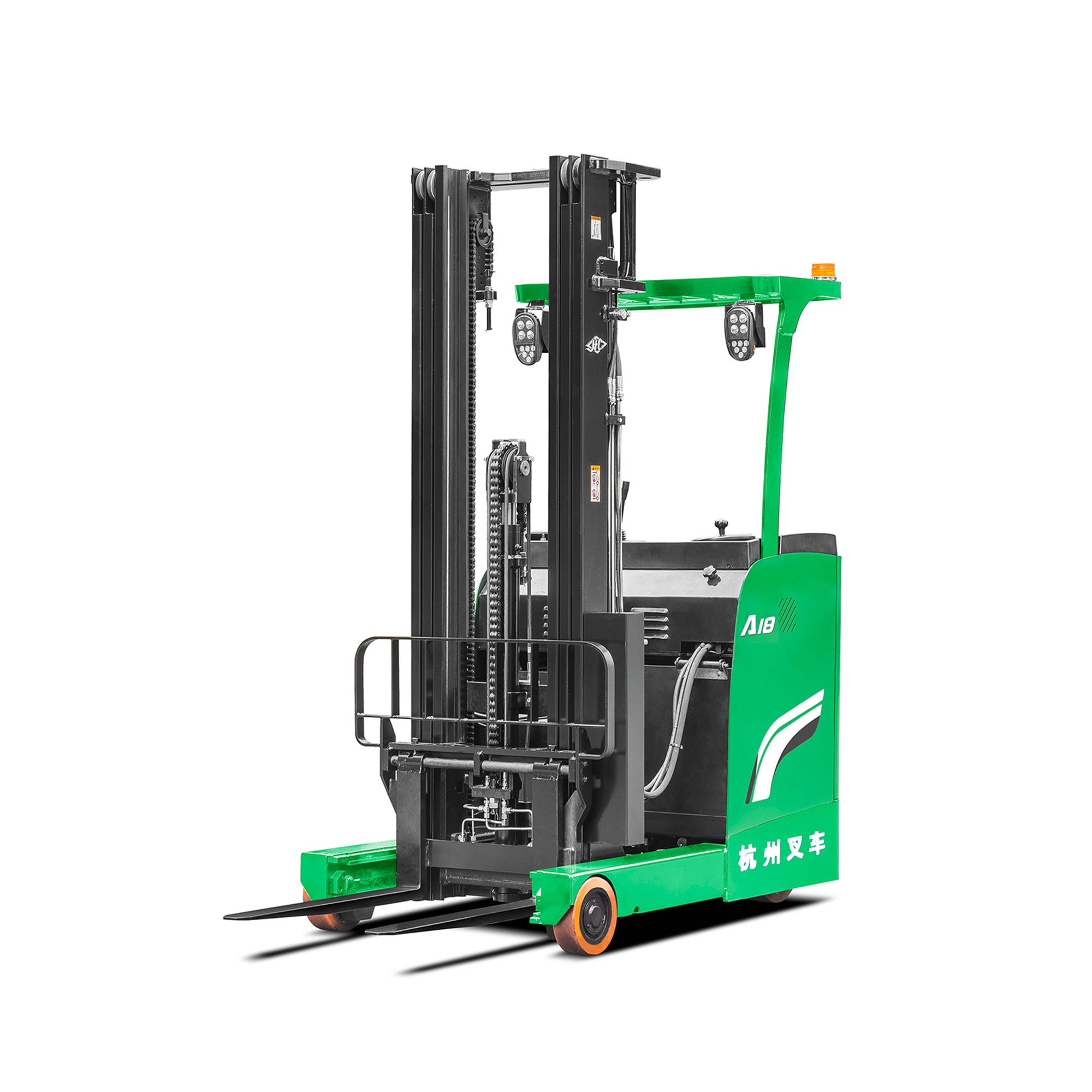
On a Raymond 7000 Series reach truck, regenerative lowering turns a routine lift cycle into a small energy recovery event. When the forks descend with a load, the drive motor switches into generator mode, feeding current back to the battery. That means less draw from the charger overnight and fewer kilowatt-hours billed at the end of the month. It’s not a gimmick—operators feel the smooth, controlled descent, and the battery gauge doesn’t dip as fast during heavy shifts.
The quiet part matters more than you’d expect in cold storage or narrow aisles. Traditional hydraulic lowering bleeds off energy as heat and noise, but regenerative lowering does the job with barely a whisper. No resistor banks switching on, no high-pitched whine. In a warehouse running two or three shifts, that reduction in ambient noise adds up to a more comfortable workplace and less fatigue. Combined with lower energy costs, it’s one of those features that quietly pays for itself.
For operations already tracking energy per pallet moved, the 7000 Series’ regenerative lowering shows up as a measurable dip in consumption. It also reduces heat buildup in the motor compartment, which can stretch component life. In practice, a lift truck that lowers loads without wasting energy is simply cheaper to run—and the only thing you hear is the tires on the floor.
Yale MR14-25: The Cold Storage Contender Built for Sub-Zero Shifts
Operating a lift truck in a freezer aisle isn't just about moving pallets—it's about trusting that every component will still respond when the mercury plunges below zero. The Yale MR14-25 doesn't merely survive those conditions; it's been painstakingly adapted for them. From the moment you step into the cab, you notice the difference: the controls don't feel stiff, the display doesn't fog over, and the mast glides rather than groans. That's not luck. It's a deliberate series of engineering choices that treat cold storage as the primary environment, not an afterthought.
The real test comes after hours of continuous shifts in and out of the deep freeze. Standard trucks often develop condensation in the electrical system, leading to erratic behavior or sudden shutdowns. The MR14-25 sidesteps that with fully sealed connectors, heated keypads, and a battery compartment that maintains a stable core temperature. Even the hydraulic fluid is selected for low-viscosity flow at -30°C, so lifting and tilting remain smooth whether you're stacking ice cream tubs or moving racks of frozen seafood. Operators stay comfortable too—the cab's insulated glass and forced-air defrost keep visibility clear without blasting heat directly at your face.
Maintenance crews will appreciate that this truck doesn't punish them for working in the cold. Quick-access panels are positioned so you don't have to remove three layers of guards just to check a fuse. The diagnostics system flags issues before they strand someone between racks, and the chassis is coated to resist the salt and moisture that inevitably get tracked in from the loading dock. In a warehouse where downtime means spoiled inventory, the MR14-25 earns its keep by simply doing its job—hour after sub-zero hour—without drama.
Hyster A Series: Where Initial Price Meets Long-Term Maintenance Reality
The sticker price on a Hyster A Series forklift can feel like a win at purchase time, but that number rarely tells the whole story. Once the unit starts clocking hours, the true cost equation shifts toward wear items, hydraulic seals, and brake components that seem to demand attention sooner than expected. Fleet managers who track cost per hour often notice the gap between the A Series and its heavier-duty siblings widening after the first 2,000 hours.
What makes maintenance reality bite is not just part prices—it is the frequency of small failures that pull operators off the floor. Electrical connectors, mast rollers, and mast chains on entry-level models tend to require more frequent adjustment and replacement. If your operation runs multiple shifts, those unplanned service stops add up quickly, turning a budget-friendly unit into a recurring line item.
The smart approach is to treat the Hyster A Series as a light-to-medium duty tool, not a substitute for a workhorse. For warehouses with predictable loads and moderate hours, it can hold its own if you stick to a strict preventive maintenance schedule. But if you buy solely on initial price, you may find the real long-term cost is spent keeping the cheaper truck working while a more robust model would have been turning loads.
Linde R14-R20: Finger-Tip Control and the Ergonomics of High-Volume Picking
On the R14–R20 series, the operator's hand rarely leaves the steering arm. Lift, lower, travel direction, and horn are all embedded within a compact control head that responds to light finger pressure—no reaching across the dash, no wrist-twisting levers. It feels less like driving a truck and more like guiding a tool you've used for years, which matters when you repeat the same pick cycle hundreds of times per shift.
The ergonomic story extends well beyond the buttons. The suspended operator platform absorbs the chatter of uneven concrete instead of passing it into knees and lower back. The tiller arm is angled so elbows stay close to the body, and the low step height means getting on and off doesn't become its own workout. For high-volume picking, where every second and every motion adds up, these details turn an eight-hour shift from borderline punishing to genuinely sustainable.
Most trucks in this class treat controls as an afterthought. Linde flipped that priority, putting the interface where the hand naturally rests and tuning resistance so even a gloved thumb can trigger functions without accidental inputs. The result is a picking loop that feels calm, predictable, and noticeably less tiring by hour six.
Jungheinrich ETV 216i: How Lithium-Ion Power Redefines Multi-Shift Workflows
The ETV 216i steps away from the old rhythm of swapping lead-acid batteries between shifts. Its lithium-ion pack accepts short, high-current charges whenever the truck is idle — during lunch breaks, between loading runs, or at shift changes. That small shift in behavior removes the bottleneck of a dedicated battery room and keeps the truck on the floor instead of waiting for a fresh power source.
Because opportunity charging is practical rather than harmful, operators don't have to nurse a battery down to 20% before plugging in. They can top up throughout the day without damaging cell life. This changes how supervisors plan multi-shift schedules: the same vehicle can roll from morning into night with no midday swap, and voltage stays consistent as the pack drains, so lift and travel performance don't sag toward the end of a shift.
The wider effect is a leaner operation. Fewer spare batteries, less racking for chargers, no acid handling or ventilation upgrades. Warehouses that used to allocate square footage to battery maintenance can reclaim that space for staging or picking. Over three shifts, that combination of continuous availability and reduced overhead redefines what a compact reach truck can handle.
FAQ
Crown RM 6000, Raymond 7000 Series, Yale MR14-25, Hyster N30-45ZR, Toyota BT Reflex R-series, Jungheinrich ETV 216i, and Linde R14-R20 tend to show up again and again in busy operations. Each offers distinct advantages in visibility, travel speed, or energy recovery.
Its mono-mast design provides better sightlines to the fork tips, and the lift and lower speeds are quick without feeling jerky. Operators often gain back seconds per cycle in very narrow aisles because the controls respond cleanly and the mast does not block the view when placing loads at height.
Cold conditioning packages, regenerative lowering, and the ACR System for smoother acceleration help keep cycle times consistent. The truck also handles steady loads without feeling twitchy, so operators can maintain a fast pace through a full shift without fighting the controls.
Toyota BT Reflex R-series and Yale MR14-25 both blend tight-aisle reach capability with enough travel speed and stability for longer runs. The Reflex models add transition lift control, which reduces mast sway when moving from receiving to racks and back.
Look for models with adjustable floor plates, low step heights, and intuitive joystick controls. The Jungheinrich ETV 216i, for example, uses a compact chassis and well-placed controls that let operators work longer without lower-back strain, which tends to keep pick rates steadier across a shift.
Energy recovery can cut battery charging downtime and reduce heat buildup. Models like the Hyster N30-45ZR and Linde R14-R20 include regenerative lowering or braking that feeds energy back to the battery, meaning less time at charging stations and more time moving pallets.
Simplified access to motors, hydraulic lines, and diagnostics matters more than most people expect. The Raymond 7000 Series and Crown RM 6000 both have onboard diagnostics that flag issues before they become failures, while modular parts make common repairs faster and less disruptive.
Conclusion
Warehouse operators chasing tighter aisles and longer runtimes often start with the Crown RM 6000, a reach truck that holds up to punishing narrow-aisle cycles without faltering. The Raymond 7000 Series takes a different angle: its regenerative lowering quietly feeds energy back into the battery, trimming electricity costs on every drop instead of wasting that motion as heat. For facilities where temperatures swing well below freezing, the Yale MR14-25 proves its worth with sealed components and heated operator compartments that keep shifts moving when standard trucks would seize or fog over.
Budget-minded fleets often compare the Hyster A Series because its sticker price looks appealing, but the real story lives in long-term maintenance: simpler hydraulic routing and widely available parts hold down repair bills over a five-year lease. Meanwhile, the Linde R14-R20 shifts attention to operator strain. Its fingertip controls and adjustable armrest reduce wasted motion during high-volume picking, so a driver can sustain accuracy through hour eight without shoulder fatigue. Then there’s the Jungheinrich ETV 216i, where lithium-ion power removes battery swapping and opportunity charging fits naturally into multi-shift workflows; a 15-minute top-up during a break can add meaningful runtime, and the truck’s lighter footprint lowers floor wear. Together these models show that maximizing warehouse efficiency is less about raw speed and more about matching the truck’s design to the aisle width, temperature, shift pattern, and the human behind the controls.
Contact Us
Contact Person: Liuxue
Email: [email protected]
Tel/WhatsApp: +86-19084200370
Website: https://www.hf-ec.com/